How to raise a critical thinking child?
 Eldar Sarajlic
·
Eldar Sarajlic
·
The challenge of parenthood
You can read all the books in the world, and get the fanciest Ph.D. degree you can find, but none of that will be enough when you face the most personal intellectual task of all: raising your own child to think well.
This is one of the most sobering realizations I had when my daughter started primary school, and when I reluctantly accepted the fact that if I really wanted her to develop the ability for critical thinking, I’ll have to teach her myself. Relying on her teachers in school is not just a waste of time: it’s an exercise in futility by definition.
School curricula teach our kids content. They’re engines for transferring facts from one address (the teacher) to another (the children). Most often, there’s no room for reflection; feedback is minimal, and systemic understanding is completely absent.
There’s some freedom to do things differently if you homeschool your child. You can avoid the cookie-cutter approach of public education by tailoring the child’s education to their sensibility and be more creative. But, you will still hit the wall when you try to design a curriculum that will teach them how to think critically.
Why is this so?
What in the world is ‘critical thinking’?
One part of the problem is the fact that critical thinking is a very vague term. It’s not really clear what it means and what skills it encompasses. I say this as a university professor whose main job is to teach a class called critical thinking. I’ve used at least a dozen of textbooks and, while there are some similarities, most of them approach the subject in their own way.
The second, and perhaps more serious problem is the anchoring of the term ‘critical thinking’ in textual analysis. Most of the approaches emphasize skills of argument evaluation. Students are asked to read texts and identify pieces of the argument (premises and conclusions) and then make judgments about their truth and validity.
But, as I’ve come to realize over the past decade of teaching it, this approach is wrong. Critical thinking is more than just the ability to analyze text. It’s about understanding how the world works and how to make good decisions when we’re unsure about the outcomes. It’s about the structure of the world that lies beneath text.
So, as any responsible parent with some expertise in education would do, I designed my own critical thinking curriculum. I use it to teach my daughter thinking skills at home, and now I’m sharing it with you.
Here’s the summary of my approach. If you have a child, feel free to use it. If you know somebody that does, share this article with them.
Five structures of reality
My pedagogical philosophy, both in classroom and at home, is based on the value of first-principles approach: I am a firm believer in starting any learning journey from scratch. To teach a child critical thinking, we should not talk about arguments first, but about the fundamental structures that govern how the world actually works.
I identified five basic structures that serve as the core of my curriculum:
- Patterns
- Causes and effects
- Uncertainty
- Models
- Decisions
These are chronologically ordered. The first structure can be taught while the child is between 8 and 11 years of age, the last one between 14 and 16. Most children are capable of understanding these structures, if they’re presented through the first-principles approach.
In my curriculum, these structures serve as the backbone of 9 modules, tailored for three distinct age groups. I’ll describe each in turn. The entire curriculum and the materials will be available here.
Ages 8-11
Seeing patterns
Before they are asked to explain or evaluate the world, children first must learn to recognize the structures inherent to it.
This module builds the first cognitive skill that underlies everything: seeing structure in reality. Children must learn to spot genuine patterns, classify what they observe, and recognize when an apparent pattern is noise, coincidence, or wishful thinking. As Douglas Hofstadter argued, all thinking is analogical, so children need first to build their mental library of patterns and structures. This will help them understand everything else that comes later much better.
Causes and effects
Once they learn how to recognize patterns, children are ready to understand connections between phenomena, and start distinguishing a special class of them: causal connections.
To truly understand something, we have to understand what produced it. And to do that, children must learn to distinguish between a cause and a coincidence, understand that causes operate through mechanisms, which can be teased out through simple experiments.
Children at this age love hands-on activities and have the ability to understand complex ways things connect to each other.
Chance and uncertainty
Understanding causality naturally leads to questions about coincidence: why (and how) some things happen by chance?
Children are pre-disposed to questions like these by default. All those why, why, why questions they bombard their parents with are basically their brains’ attempts to break through the initial randomness of experience. Teaching them about uncertainty and the ways it can be tamed through concepts like probability is a sure way to prepare their minds for complexity they’ll encounter later in life.
Ages 11-13
Models and explanations
Around the age of 12, children are ready to understand that the world sometimes resists full explanation: there is always an irreducible gap between the reality and our attempts to explain it. This is the best age to introduce the idea that all explanations of the world are like toys: they are imperfect and simplified models of the real thing.
Children should learn that explanations are testable and editable: they should learn how to recognize their limits, and how to improve them so they match the reality better.
Systems and feedback
Any child that spends some time surrounded by large groups of other children begins to understand that systems often behave differently from individual events. Some systems have feedback loops (the more you appease a bully the more he will bully you); some have unintended consequences (focusing on one friend too much makes others feel neglected); while others settle on an equilibrium (kids settle into stable friend groups where no one keeps switching).
Understanding the features of complex systems, such as traffic, nature, or a society, will carve a path for true critical thinking later down the road. It’s a skill that will pay immense intellectual dividends once they reach college.
Human behavior
By the time they reach the age of 12 or 13, children will have already learned a few things about human behavior. But, what they really need is to systematize those lessons in a structured way.
They should understand some basics of human psychology, from responsiveness to incentives and environments (leaving your things unattended will encourage thieves to steal them), to conditions for cooperation (kids share more when turns are enforced), and the evolution of social norms.
In most educational curricula, these thinking skills are completely neglected, and kids are left to learn them on their own, through mistakes, and often with a lot of emotional pain and anxiety.
Ages 14-16
Decisions and tradeoffs
By the time they reach high school, children (now teenagers) face real decisions with real consequences: what to study, who to trust, how to spend their time, when to take risks. Most of them navigate these choices on instinct, because nobody has taught them to do it any other way.
One of the most important things they must learn at this age is that every decision is a tradeoff. Choosing one thing always means giving up another. Teenagers are ready to understand concepts like opportunity cost, risk versus reward, and the difference between a decision that turned out badly and a decision that was made badly. The distinction between outcome quality and decision quality is one of the most important ideas a a budding mind can internalize.
Truth and evidence
We live in an age of noise. Claims compete for attention everywhere, on screens, in conversations, in the news. Teenagers need more than opinions about what's true. They need a method for evaluating evidence.
To develop that skill, they must first learn to ask the questions that matter: What kind of evidence supports this claim? Is this based on observation, experiment, or someone's guess? Can this prediction be tested? What would change my mind?
The goal is not skepticism for its own sake, but the ability to tell the difference between a well-supported claim and a poorly-supported one, and to hold one's own beliefs to the same standard.
Understanding the world
Finally, children must learn to apply critical thinking concepts to the real world. In the last module, they learn how to analyze real systems: economies, institutions, policies, technologies. They learn how make predictions and evaluate them. They examine how complex problems resist simple solutions, and why well-intentioned decisions sometimes produce the opposite of their intended effects.
Can children really learn all this?
You may think that these are complex lessons that should be taught in college, not in middle and high school.
But, if you wait for college professors to teach these skills to your child, you’re already late. Colleges are not much different from schools: they all emphasize content and rarely go back to first principles to build the students’ knowledge.
The main strength of my critical thinking curriculum is its sequential nature: each structure builds on the previous one. That’s what learning critical thinking from first-principles means; one cannot understand causation without first recognizing patterns; one cannot reason about uncertainty without understanding cause and effect; one cannot evaluate models without grasping that the world contains irreducible randomness; one cannot navigate systems without understanding models; and one cannot make good decisions without understanding all of the above.
Most educational approaches skip this progression entirely. They jump straight to arguments, or to logic puzzles, or to debates, activities that look like critical thinking on the surface but lack the structural foundation underneath. It's like asking a child to write an essay before they've learned to read.
Where to start
If your child is between 8 and 11, the place to begin is with patterns. This is the foundation everything else rests on. Not just patterns in the abstract, mathematical sense, but patterns as they appear in the world your child already inhabits: in nature, in music, in the way people behave, in the games they play, in the stories they love.
The goal at this stage is not to make children into little logicians. It's to train their perception, and to help them see that the world is not a chaotic mess of unrelated events, but a place with structure that can be discovered, understood, and sometimes used to predict what happens next.
And crucially, to teach them that their own brains can fool them. That a pattern can feel real and still be a coincidence. That seeing something three times doesn't make it a rule. That confirmation bias is not something that happens to other people.
I took all of that seriously, so much that I wrote an entire book about the first module for my daughter to read and learn. Recently, I decided to make it available to you as well, in case you agree with the points I made above.
The book, entitled Seeing Patterns contains 52 weekly lessons (one per week, about 20-30 minutes each) that take a child from their first encounter with patterns (in nature, shapes, music, etc) to concepts like randomness, correlation versus causation, and the surprising ways our minds create false connections. Each lesson includes a story, a thinking challenge, discussion questions for parents, and a hands-on activity. I wrote it in a simple and formulaic way, requiring no prior knowledge to teach (or read) it, from the parent or the child.
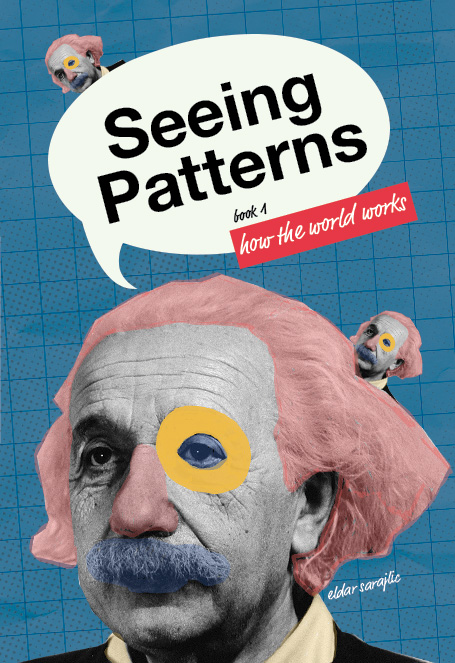
You can get the book here, and read more about the rest of the curriculum here. The follow ups to this one are already in the works.
Whether you use my book or design your own approach, the underlying message is the same: your child's school is almost certainly not teaching them how to think. That job falls to you. And the good news is, it's not as hard as it sounds, if you start with the right structure.
The world has a hidden order. You can help your child learn to see it.
Let me know if you have any questions, I’d be happy to help.
Stay sharp
New research and test-prep insights, straight to your inbox.
What next?
Start with a free baseline test. Full exam, full error analysis, no credit card.
SHSAT Prep
Full-length adaptive practice tests reverse-engineered from the official DOE handbooks. Free baseline test with error analysis.
Start SHSAT prep →See the science behind it
How we analyzed over 1,300 questions and five thousand answer choices to figure out what the SHSAT is really made of.
See the method →Free baseline test
100 questions. Full error analysis. No credit card required.
Start the free baseline test →