The secret behind all good thinking is simple
 Eldar Sarajlic
·
Eldar Sarajlic
·
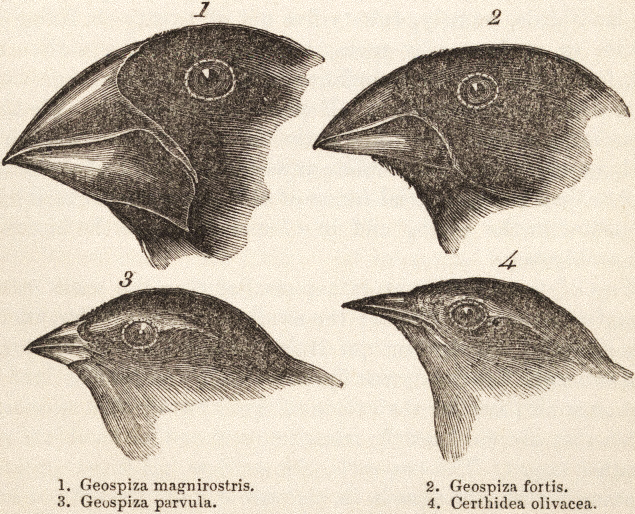
In the early decades of the nineteenth century, a young naturalist named Charles Darwin spent five years aboard the HMS Beagle observing nature with a particular eye for detail.
I guess you are familiar with the story: on the Galápagos Islands he noticed that finches on different islands carried beaks of noticeably different shapes. As we know now, this variation is not random; each form is suited to the seeds, insects, or cactus fruit available locally. That was Darwin’s insight that revolutionized modern biology.
Imagine someone else in Darwin’s place. Most travelers might have recorded the birds as a set of curiosities and moved on. After all, both variation and regularity in nature appear wherever we look; finding similar birds with different beaks might not have been too surprising.
But, Darwin didn’t just observe. He began to wonder whether the differences could be explained by a smaller number of processes acting over long periods, such as inherited variation, limited resources, and the survival of those individuals better equipped to exploit what was at hand.
He could have noted those variations as encyclopedic exceptions. But, instead, he produced an explanation focusing on a single, economical mechanism capable of producing the branching diversity of life from simple, repeated conditions. In other words, he simplified the story about the causes of those variations.
More facts is not always better
This right here — simplicity — is the ultimate mechanism of critical thinking, and the driver of most scientific breakthroughs in history.
It’s an interesting, yet neglected concept. Many people assume that to arrive at some intellectual breakthrough one needs to collect more and more facts until a pattern declares itself. But that’s actually far from the case. To Darwin, it arrived when he tested whether fewer rules, applied consistently, could still generate the observed range of outcomes. Simplicity is a function of the economy of explanation, and such economy is the evidence that the active underlying (causal) principles have been located.
It is not an exaggeration to say that arriving at simplicity in your thinking is when actual understanding happens. To understand something, you don’t need more facts: you need a simpler explanation. A physician presented with a patient’s scattered symptoms can keep adding possible causes, but the diagnostician who has learned to look for the single account that accommodates the largest number of findings without contradiction or ad hoc adjustments is the one truly understanding what’s wrong with the patient.
All eureka moments in the history of science were instances of arrival at the point of simplicity.
The centrality of simplicity
This warrants a claim that the habit of testing whether a smaller set of conditions can still account for what is perceived is central to what deserves to be called good (critical) thinking. Simplicity is the ultimate thinking virtue, the queen of mental processes that produce extraordinary results. Unfortunately, many teachers and proponents of critical thinking fail to appreciate it properly. Most descriptions of critical thinking often stress the standard elements found in most textbooks: identifying assumptions, weighing evidence, considering alternatives, etc.
Don’t get me wrong, these operations are important, but they remain mere decoration until the thinker has first isolated what, at bottom, is doing the work in the situation under examination. Without that isolation, scrutiny tends to multiply distinctions rather than resolve them. You can’t analyze things forever: you need some synthesis, and simplicity is the path to it.
All simplicity is reductive. Unnecessary details are discarded, core elements are emphasized and tied together. But, this reduction is not performed by ignoring detail. It is reached only after the full particularity of a problem has been held in attention long enough for the nonessential elements to show themselves as dispensable. A statement that survives this process is short because everything that could be removed without distorting the outcome has already been removed. The brevity is a record of prior work, not an avoidance of it. It’s like a marble sculpture, skillfully chiseled by a master sculptor: when all that is unnecessary is removed, what remains is the true essence.
A stepping stone to complexity
Once that work is done, more complex questions becomes possible, and they can reveal deeper structures and causes behind everything: If this process or system is operating as described, what single modification in its conditions would produce a different result?
This question cannot be answered usefully until the generative core of the process has been separated from the surrounding texture. When it can be answered, the thinker gains a place to stand, and gains an actual lever rather than a description of the entire machine.
The same lever is then transferable: it can be recognized in other domains. For example, a historian who has reduced a political crisis to the few structural pressures or decisions that made alternative outcomes unlikely can sometimes recognize analogous structures at work in economics or environment. An engineer who has traced a system failure to one simple relationship can notice similar relationships in biological or organizational settings.
The surface details differ, but the underlying architecture travels. This portability is a direct consequence of having preserved only what remains invariant across changes in context. Many people, like Douglas Hofstadter, have recognized the importance of these ‘traveling structures’: these are analogies, or patterns, the engines of creative thought.
The opposite habit—treating every observed factor as potentially decisive and piling them up as much as possible—leaves no basis for priority. Every element appears equally relevant because none has been tested for dispensability. Intervention or critique then lacks a clear point of application. The result is a kind of paralysis in which description multiplies without producing traction on the phenomenon itself.
Another form of depth
What the pursuit of this form of simplicity ultimately reveals is that the world contains regularities sturdy enough to be isolated and carried everywhere. The world is not simple, but those regularities are. The thinker who learns how to locate those regularities acquires, over time, a growing (and extremely empowering) sense of which features of a situation are likely to repay close attention and which can be set aside without loss. That discrimination is what allows understanding to accumulate rather than merely expand. That’s the key element of what is called domain expertise.
In this light, simplicity is not the opposite of depth. It is the form depth takes when it has finished its work on a particular question. The surface may remain intricate, but the lever that moves the system has been simplified and made visible. Once visible, it can be examined, adjusted, or resisted with some prospect of consequence.
Everything else remains commentary without a handle.
Stay sharp
New research and test-prep insights, straight to your inbox.
What next?
Start with a free baseline test. Full exam, full error analysis, no credit card.
SHSAT Prep
Full-length adaptive practice tests reverse-engineered from the official DOE handbooks. Free baseline test with error analysis.
Start SHSAT prep →See the science behind it
How we analyzed over 1,300 questions and five thousand answer choices to figure out what the SHSAT is really made of.
See the method →Free baseline test
100 questions. Full error analysis. No credit card required.
Start the free baseline test →