Why I regret not homeschooling my child
 Eldar Sarajlic
·
Eldar Sarajlic
·
I've been teaching critical thinking at a university in New York City for over a decade. Philosophy ideas, logic, argumentation, the whole shebang. Every semester, a fresh cohort of students walks into my classroom, and every year, the same thing happens.
They're bright and opinionated. Many of them have very strong views about politics, society, the economy, racism, gender, you name it. But when I ask them where those views come from, or how they'd know if they were wrong, I get blank stares, or (in the best case scenario) relativist explanations: “Those are just my personal views”. This is by far the most prevalent cognitive framework of an average freshman.
Relativism aside, there’s very little, if any, understanding of the process of thinking and the methods that make it successful. And I get it, partly. These are kids who just entered a university classroom; they’re (perhaps) unaccustomed to Socratic teaching and deeper engagement with ideas.
But I think the problem is deeper than just that. Most of those kids are a result of a decade of education that skipped the most important part: learning how to think critically.
Where is the problem?
We can speculate on the root cause of this problem. I’m sure there are things we can say about teacher training, bureaucratic management of education, government policies that distort incentives, etc. But, I think an important part of the problem is how we conceptualize what is critical thinking to begin with.
If you wonder what’s wrong with that, try defining it yourself. What do you think critical thinking actually is, and how it should be taught?
There's a belief embedded in how we educate people, from primary school all the way to graduate programs, that has gone unquestioned for so long it's become invisible. The belief is this: if you fill a person with enough content, thinking will follow automatically.
There’s a whole tradition of thought that takes this as the starting assumption.
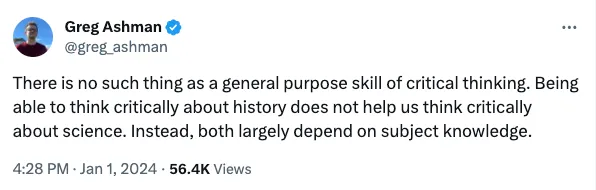
I think this is not correct, overall. While I do believe that content matters, there’s more to critical thinking than that. And, if you’re honest, you’ll recognize that we see the results of such assumptions everywhere: educated people who can't reason under uncertainty, professionals who mistake confidence for correctness, adults who hold strong opinions about complex things and have no mechanism for evaluating whether those opinions are any good.
Social media networks are full of folks like these. These aren't stupid people. They're just people who were taught what to think, but never how.
The distinction sounds simple, but the consequences of ignoring it are not.
Then my daughter started school
Teaching critical thinking gave me some abstract understanding of this problem. For years, I had taught it by following the dominant practice, but I had a growing feeling that something was off. I could not describe it well, and I confused it with my own insecurities as a young academic.
But, then it became personal.
I remember the first day my daughter started kindergarten. My wife and I were gleaming with pride as we took pictures in front of our neighborhood school; our daughter all dressed up, her backpack filled with pencils, crayons, and notebooks, ready for an exciting new phase of life. She could already read and write, courtesy of our home efforts and our family tradition of valuing books and knowledge.
The excitement about her being part of a large public educational system slowly waned, however, as I learned more and more about the ways young minds are educated. The curriculum is rich in content (though it could be even richer) but almost entirely silent on developing thinking practices. Social studies and science are mostly based on mere fact delivery; math is based on drilling formulas and arithmetic methods. There’s very little about what lies between the disciplines — the patterns, the intuitions, the concepts — that could explain not just the facts and formulas, but also teach kids that there is a larger structure beneath all reality.
In other words, the space between the two, focused on answering the question “why does the world behave like this?”, was largely absent.
It took me a while to understand and accept this. At first, I’d tell myself I was being professionally overcritical (I am a philosopher of education after all, and we’re prone to overcriticism). But, I wasn't. Listening to other parents come to a similar conclusion confirmed it.
Slowly, I had come to regret not homeschooling my child.
I find this a funny thing too, since just before the pandemic I did a lot of research about homeschooling. I read literature about it, presented at conferences, and developed some views. While not fully against it, I had reservations about the practice (mainly influenced by what I read from philosophy journals) because I believed (and still do) in what a philosopher Joel Feinberg called “the child’s right to an open future”: the principle saying that parents have an obligation not to foreclose their children’s intellectual and personal development in directions that go against parental beliefs or culture. For example, according to this principle, it would be wrong for a parent to indoctrinate a child in a particular ideological view and prevent the child for changing their opinion.
While I still believe this is a right parental disposition in general, I think I overestimated the ability of public schools, and underestimated the parental ability to secure that right. If schools don’t teach children to be good critical thinkers, then they’re doing the most damaging thing possible for their open future: they are not providing children with a cognitive apparatus to think for themselves, and not be slaves to popular trends, zombified and TikTokified consumers of cultural slop.
So I did the only thing that made sense to me: since I can’t, unfortunately, homeschool her (you try living in NYC on a single salary in a family of three), I decided to build a custom-made critical thinking curriculum for her, from scratch. I am using it now to teach her at home all the things she won’t learn in school.
I am a professional educator, so it was somewhat easy for me to do that. However, I did it not do it as an academic, but as a father who wanted something specific for his daughter that didn't seem to exist anywhere else. I developed a structured, sequential program that starts from the most basic cognitive skill and builds from there, one concept serving as the bridge for the next, that will last for years.
I decided to share that with the world, so other parents can see what I am building, and perhaps benefit from it too. I’ll describe it below so you could see how simple, yet unique, this approach is. I don’t think this is mysterious — these are all common-sensical ideas — which makes me even more puzzled about why don’t schools already do this.
What that curriculum is built on
The central idea of my entire approach is simple, even if its implications aren't: reality has structure.
What do I mean by this?
I mean that the world doesn't behave (fully) randomly. It operates according to patterns.
When we understand these patterns (how they look, how they reproduce, how they fool us), we can reason about the world in a much more powerful sense. For example, we can use probabilities, discover causes, create explanations and make decisions that will be better than plain guessing, gut feelings, or trusting random influencers on Instagram. We can see the structure amid chaos.
These aren't abstract philosophical concepts, even though they may sound so to an untrained ear. These concepts reveal the actual architecture of how things work, from weather systems and financial markets to the dynamics of a friendship group in middle school.
I want my daughter to understand these structures because I want her not just to know more than others: I want her to think differently about what she knows.
To achieve that, I organized the curriculum around five structures that govern nearly everything that happens:
Patterns
First, of course — patterns. Pattern recognition is the most basic cognitive skill of any thinking creature. Even animals have it in rudimentary form; that’s what helps them survive and navigate their environment.
But for humans, it goes beyond that. Patterns help us see reality: we must do that first so we could process it. Before a child can reason about causes, or evaluate evidence, or make a decision under uncertainty, they need to be able to see structure in the world at all.
I don’t mean patterns here in the abstract sense, but patterns as they appear in nature, in music, in the way stories end, in the behavior of people around them. Children already have the ability to see them, but most curricula don’t lean on this to deepen their understanding of the structure behind appearances in reality.
This is the foundational skill for critical thinking. You can't build anything else on top of it until this part is solid (I think this is what most content-driven interpretations of critical thinking hint at).
Chance and uncertainty
Understanding patterns leads directly to questions about coincidence. Why do some things happen by chance? How do we reason carefully when we can't be certain? Are all patterns meaningful?
These are questions students usually learn much later, either in AP statistics classes in high-school or in college, but the intuitions for it must be built earlier. Perhaps the absence of this intuition is why most kids shy away from statistics and see it as dry and boring (while the field is all but that!).
Children actually do encounter questions about chance and uncertainty much earlier (by the age of ten the latest), and almost nothing in the regular school curricula give them any tools to answer them.
Causes and effects
Once a child can recognize genuine patterns and understand probabilistic nature of some phenomena, they're ready to think about connections between things, specifically, the special class of connections: causal ones.
Understanding what produced something is one of the most practically useful thinking skills there is, and one of the most routinely confused.
“Correlation is not causation” is a phrase everyone has heard, but almost nobody applies it consistently, nor really understands the real difference between the two.
Models and explanations
Around twelve and up, children are ready to understand that every explanation of the world is a simplification. The world is more complex than our words and concepts may convey.
Around this age they should learn explicitly that maps are not territory, and that models (as explanations) are not reality.
They have to learn that the question here isn't whether an explanation is perfect, but it's whether it's useful, testable, and/or better than the alternatives.
That shift in how a child thinks about knowledge is significant, and can ensure the child’s resistance to easy indoctrination later down the line.
Decisions and tradeoffs
By high school, the stakes of thinking will become real. Children already intuit that every decision is a tradeoff. Choosing one thing means giving up another: spending early Saturday mornings at a swimming practice means foregoing a TV-binge on Friday night; eating too much candy means foregoing a pimple-free face.
At this point, children should understand the difference between the quality of the decision making process and the quality of the outcome. This is one of the most important distinctions they should be aware of: a decision made badly is fundamentally different than a decision that was made correctly but turned out badly (for unforeseen, random or non-random reasons).
Almost no curriculum teaches kids this. But, I do.
Where to start
Most educational approaches that gesture at critical thinking skip this progression entirely and frame it completely differently. They usually jump straight to logical fallacies, or argument mapping, or debate techniques. Critical thinking is understood primarily as analysis of text and communication.
Don’t get me wrong; these aren't useless technique. But they're being taught in the wrong order, to a foundation that hasn't been built yet. It's like teaching someone to write an essay before they've learned to read. The surface activity is there, but the underlying capacity isn't.
That’s why I structured my curriculum in a sequential order, rooted in the skill of pattern recognition, and ending in lessons about decisions and systemic thinking.
Each of the five structures in this curriculum requires the previous one. You can't reason clearly about cause and effect without understanding uncertainty. You can't evaluate an explanation without grasping that the world contains irreducible randomness. You can't make good decisions without understanding all of the above.
The sequence follows the actual logic of how thinking develops.
If you are a parent, and you think this is a good framework to teach your child critical thinking, then I invite you to check it out, use whatever you want from it, discard what you don’t need (maybe your child knows all of this already — kudos to you).
I am building the entire curriculum at www.schoolofcriticalthinking.org, where I will post sample lessons, share materials, and offer my support to like-minded parents.
If your child is between 8 and 12, the place to begin is with patterns. I just published the first book in the curriculum (out of 9 envisaged) — Seeing Patterns — contains 52 weekly lessons (enough to fill an entire year) that take a child from their first encounter with structure in the world to concepts like randomness, correlation versus causation, and the many ways our minds manufacture false connections.
Each lesson can be done in 20 to 30 minutes, and I wrote them in an interactive fashion, so you could read them together with your kids. The good thing about it is that no specialist background required to teach it: any parent could serve as their child’s teacher (we are usually the best teachers to our kids anyway). You could do one lesson per week, in order, for a year, or speed it up a bit if your child wants it.
I firmly believe that half an hour a week is a small investment of time for what I think is the most consequential skill a child can develop. I don’t say that only because I'm selling you something, but because I watched what happens to people who never develop critical thinking, for long enough to be sure.
You can find the book here, and read more about the full curriculum here.
Let me know if you have any questions, I’d be happy to respond. If you’d like a copy of the book but you can’t afford one, I’ll send you one for free, just reach out.
Stay sharp
New research and test-prep insights, straight to your inbox.
What next?
Start with a free baseline test. Full exam, full error analysis, no credit card.
SHSAT Prep
Full-length adaptive practice tests reverse-engineered from the official DOE handbooks. Free baseline test with error analysis.
Start SHSAT prep →See the science behind it
How we analyzed over 1,300 questions and five thousand answer choices to figure out what the SHSAT is really made of.
See the method →Free baseline test
100 questions. Full error analysis. No credit card required.
Start the free baseline test →