What should your teen read first? Mapping the hidden difficulty of great literature
 Eldar Sarajlic
·
Eldar Sarajlic
·
Do you remember the first moment you read a classic of world literature on your own, without school or parents forcing you to do so? What were your thoughts about it?
My first introduction into the great literature was Fyodor Dostoyevski’s Crime and Punishment. I read it as a teenager, sometime in high-school. I chose to read it because an older friend, a cool guy we admired, suggested we do so.
I can’t say I understood much, but I liked it enough to continue reading books. I eventually made a career out of book reading and writing — I became an academic — but I never stopped thinking about that particular choice.
What if I chose some other author as my first introduction to great books? What if I didn’t like it? Would I have not grown into an avid reader?
The first serious encounter with literature is more than just about finding a good book: it’s about creating a relationship between a young reader and the world of ideas. So, it’s worth spending some time thinking about it.
Why teenagers abandon great books
Now I’m not a teenager anymore (duh!) but a parent of a child on the cusp of teenagehood, and I grapple with the same question, just from the other side of the pedagogical fence: which books should I recommend my child to read?
It’s not a trivial question, despite the common refrain that kids should “read more classics.” Sure, they should, but which classics are introduced first may have an effect on the reader’s experience, and can impact their willingness to read more.
For example, I recently tried to hook my 11yr old on Kurt Vonnegut, by giving her The Sirens of Titan, but she wasn’t too enthusiastic about it. I wondered why, and concluded that it was either too difficult for her or that she just didn’t like his writing style.
But, what actually makes a book difficult? We often talk about books as if they exist on a simple ladder, from “easy” to “hard.” But reading difficulty is more complicated than that. A book can challenge us because its vocabulary is unfamiliar, because its sentences are dense, because its ideas are abstract, or because it requires some particular background knowledge.
This got me thinking about the great works of world literature and ways to understand how complex their reading experience might be. If we want to suggest our budding teenagers a classic to read, we may want to do so in a way that will make this reading experience be at the right level of difficulty, neither too easy nor too hard, spurring a life-long habit of reading instead of boredom or frustration.
So, I decided to analyze a set of great books for their linguistic features using some basic NLP (Natural Language Processing) techniques, to find out which types of authors have writing styles that might be too challenging for teenage readers. I’ll show you the results of this analysis, but I’ll also explain how I did it. Critical thinking can be substantially helped by some computational methods, and I’m a great fan of NLP. I think it’s a great way to extend our reasoning capacities using the powers of computer-assisted quantitative analysis.
If you’re new to this, don’t worry. The basics are very simple and intuitive, and once you see them, you’ll become a fan of NLP too.
Corpus and method
For this experiment, I selected a small corpus (an NLP term for the set of chosen works) of classic works from fourteen influential authors across different periods, genres, and intellectual traditions. The goal was to create a diverse sample that would allow us to explore an important question: do different kinds of great writing create different kinds of reading challenges?
Let me preamble that my intention was never to give some definitive ranking of writers or to claim that one book was better than another. I leave that to literary critics. What I am doing here is a very limited analysis, with limited reach and conclusions.
The corpus includes works of fiction, philosophy, essays, science, and social criticism. Here are the authors and their books I selected:
- Jane Austen — Pride and Prejudice, Emma, Sense and Sensibility
- Fyodor Dostoevsky — Crime and Punishment, The Brothers Karamazov, Notes from Underground
- George Orwell — 1984, Animal Farm
- Ernest Hemingway — The Old Man and the Sea, A Farewell to Arms, The Sun Also Rises
- Oscar Wilde — The Picture of Dorian Gray, The Importance of Being Earnest, De Profundis
- Virginia Woolf — To the Lighthouse, A Room of One’s Own, Mrs Dalloway
- Henry David Thoreau — Walden, Walking, Civil Disobedience
- Ralph Waldo Emerson — Nature, Essays
- Plato — The Republic, Phaedo, Apology
- Bertrand Russell — The Problems of Philosophy, Why I Am Not a Christian, Proposed Roads to Freedom
- Friedrich Nietzsche — Beyond Good and Evil, Thus Spake Zarathustra, The Birth of Tragedy
- Charles Darwin — On the Origin of Species, The Descent of Man, Voyage of the Beagle
- Marcus Aurelius — Meditations
- Arthur Schopenhauer — The Basis of Morality, Studies in Pessimism, The World as Will and Idea
I selected these authors because they represent different ways of engaging the mind (these being publicly available through Project Gutenberg made the choice easier). Some are primarily storytellers; others are philosophers, scientists, or cultural critics. Some challenge readers through abstract argument, others through style, imagery, or unusual perspectives.
This literary diversity allows us to ask a more interesting question than simply “which books are easy or hard?”. Namely, we can ask what kinds of intellectual challenges do different writers present to a developing reader?
The first methodological question that needs answering is: how exactly can we measure this?
Unless we wish to make this a matter of subjective analysis, we need some objective benchmarks (with a tacit acceptance that these benchmarks are reductive by nature — they don’t tell us everything about any piece of writing).
A reader experiences text difficulty through multiple channels, so it made sense to me to use these benchmarks:
- Sentence structure. A writer can make ideas difficult by packing many relationships into a single sentence. An objective benchmark for this is sentence length.
- Word complexity. Some authors rely on longer, less familiar words. An objective benchmark for this is syllables per word.
- Vocabulary richness. Some writers challenge readers not through complex sentences are complicated, but through exposure to a wider range of language.
- Overall readability. Some books combine several sources of linguistic complexity, making them easier or harder to read overall. We can create a more complex metric by combining the previous benchmarks.
First result: not all difficulty is the same
The first thing I examined was sentence structure. Long sentences force readers to hold more information in working memory before they can arrive at the author’s point. Every additional clause, qualification, or digression asks the reader to remember what came before while integrating new information. Anyone who has struggled through a page of Kant or Schopenhauer (or, God forbid, Hegel) knows this feeling.
Word choice introduces a different kind of challenge. Longer words (consisting of more than two syllable) are not inherently more difficult, but they tend to represent more specialized or abstract concepts. Over the course of an entire book, average word complexity becomes a surprisingly informative measure of linguistic style.
By plotting these two dimensions together, we can begin to see how different authors construct difficulty.
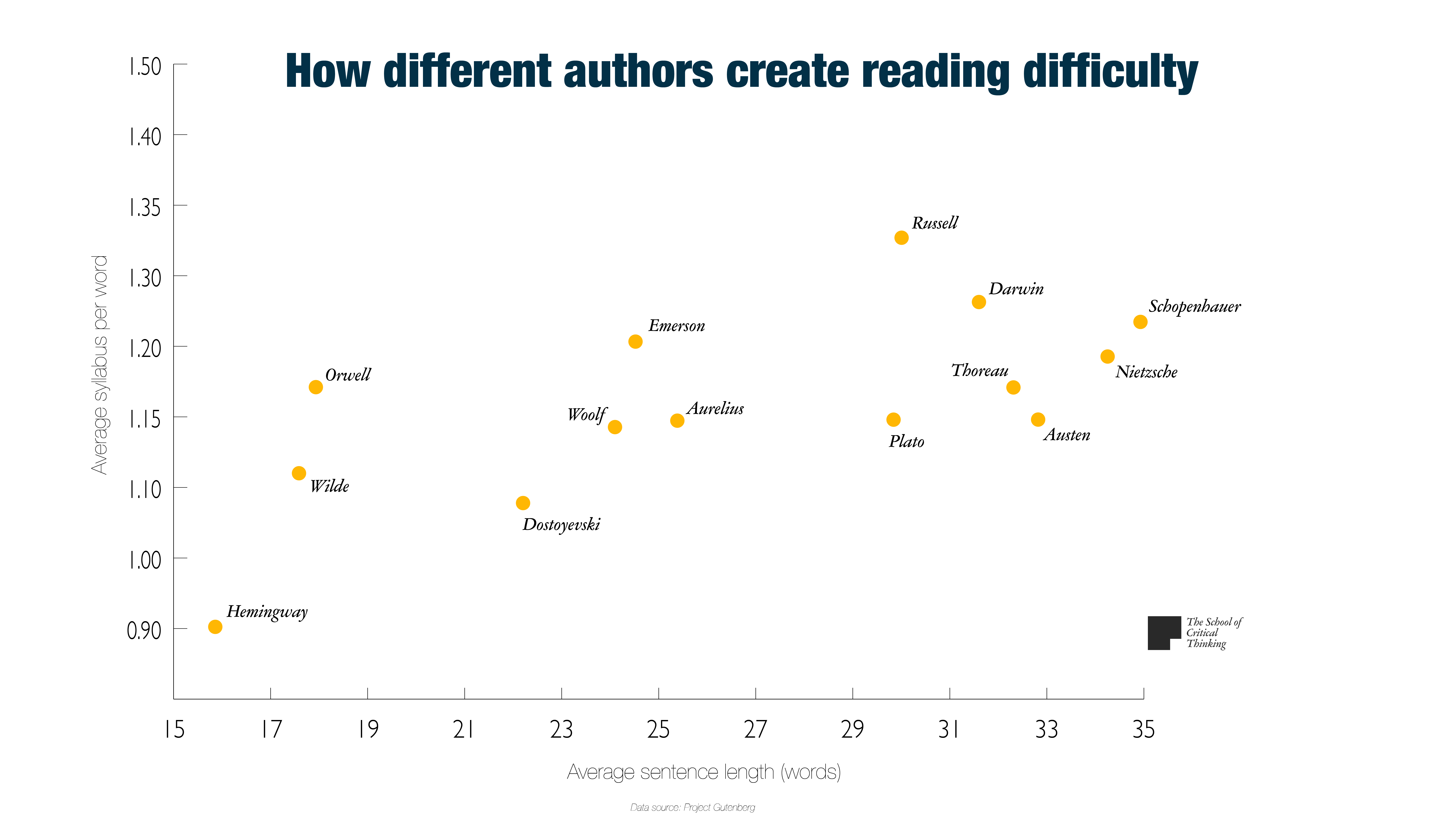
The visual result confirms some intuitions. For example, Hemingway sits at the lower left portion of the chart: he was famous for short sentences and a relatively simple vocabulary. In stark contrast, Schopenhauer lies at the opposite extreme, combining long, intricate sentence structures with more complex words.
But the more interesting observation is everything in between. Wilde, Plato, Woolf, Orwell, Russell, and Thoreau each occupy different regions of the graph, suggesting that there is no single recipe for difficult writing.
Instead of a ladder, literary difficulty more resembles a landscape. Reading difficulty is a finely-grained measure, but some things provide guidance for parents of teenagers: Hemingway, Orwell, and Dostoyevski are better introductory writers than Nietzsche and Austen for young minds with a short attention span (if Hemingway was alive today, I’m sure he’d be a great Substack writer).
Rich vocabulary is not the same as difficult prose
Sentence structure, however, tells only part of the story.
We could easily imagine two authors who write sentences of equal length, while one of them repeatedly uses the same familiar vocabulary, and the other constantly introduces new expressions or unfamiliar words. Even if their sentence structure is similar, one of them will be harder to read than the other.
To measure this, I calculated lexical diversity, a measure of the proportion of unique words used by each author.

There’s something surprising about this one. Thoreau, Emerson, Woolf, and Wilde exhibit remarkably rich vocabularies, yet, when you compare with the previous chart you notice that they are not necessarily the authors with the highest overall reading difficulty. Meanwhile, writers such as Russell and Schopenhauer often derive much of their complexity from sentence structure rather than vocabulary alone. It’s interesting to see Darwin at the bottom of this scale. Scientific writing, as you might guess, tends to be more precise: the fewer new words the better.
This illustrates an important principle that extends well beyond literature.
We often compress complex phenomena into a single number (like difficulty, intelligence, or creativity) but meaningful concepts usually consist of several independent dimensions. Reading is no exception.
Readability
How ‘readable’ is a piece of writing may be thought of as vague or subjective. What is more readable to one person may be less readable to another, depending on their reading skills, of course, but there is actually a way to measure this objectively.
The most common measure used in computational linguistics and NLP is the Flesch Reading Ease, developed by Rudolf Flesch in 1948. It uses the the average sentence length and the average syllable per word to compute a scale between 0 and 100 (where 0 is a very unreadable and 100 is a very readable text). From this original scale, in 1975 J. Peter Kincaid created a Flesch-Kincaid Grade Level measurement, which describes the readability by tying it to a school grade level. A piece of writing with, say 10.3 score, is readable at the 10th grade level.
Let’s see which grade-levels are writings of our selected authors:
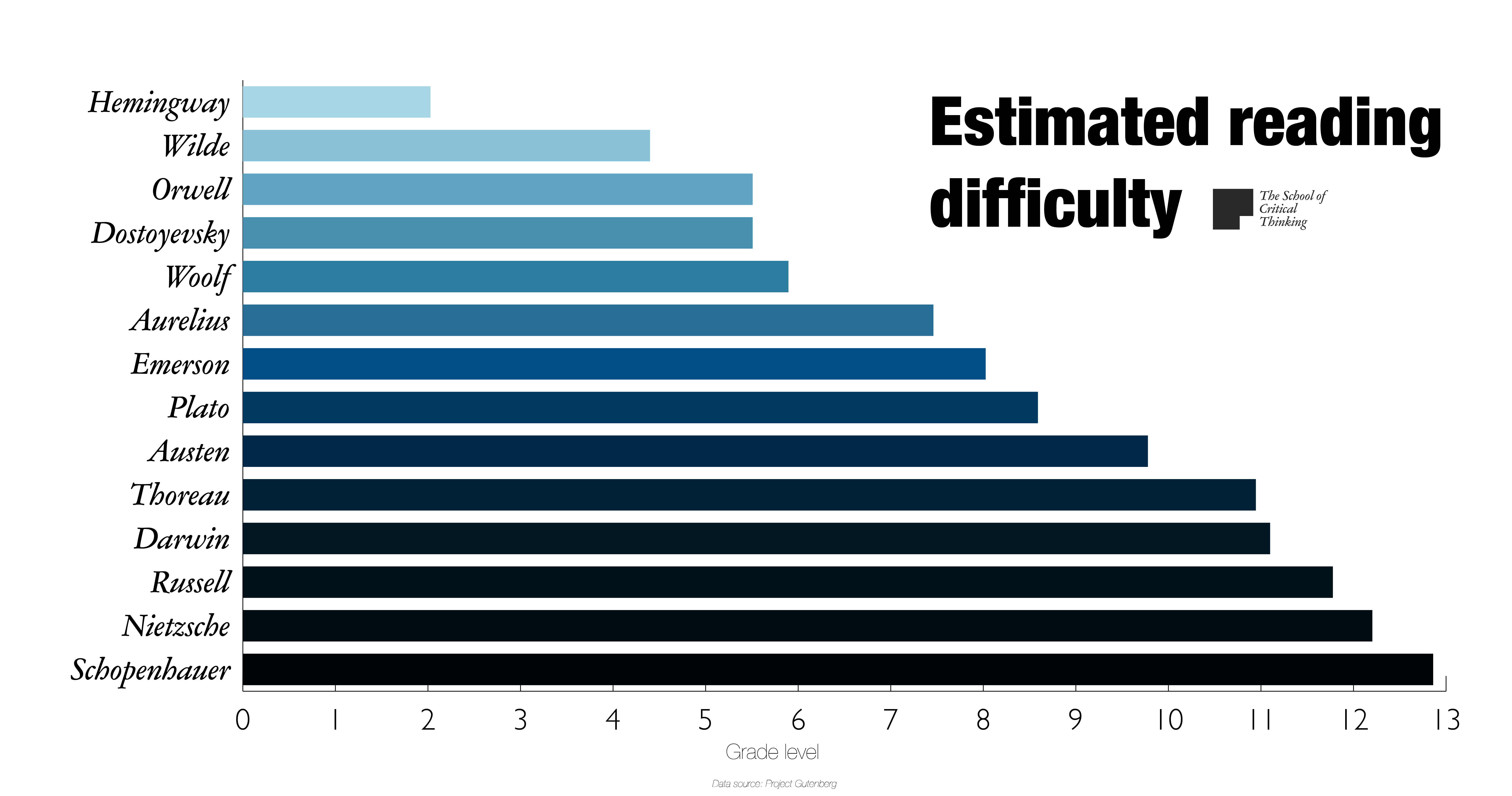
Perhaps it is then not surprising that Hemingway is the most, and Schopenhauer the least readable in this group of authors. The surprising instance — in comparison to vocabulary richness from the previous chart — is Oscar Wilde.
This is a good example that an author could have a very rich vocabulary (plenty of uncommon words) yet be very readable due to his/her relatively short sentences, or usage of words without many syllables (it also points out to a limitation of any single measure, which is why we’re using a few here).
Literary style
But, could we somehow express all of them together, using a combining metric that also allows us to see how close some of these authors are to one another along some of the benchmarks we used?
Yes, we can, because statistics gives us a useful method (called Principal Component Analysis, or PCA) that compresses several measurement into a smaller number of dimensions (while preserving maximum information possible).
Here’s how that looks like on a chart:
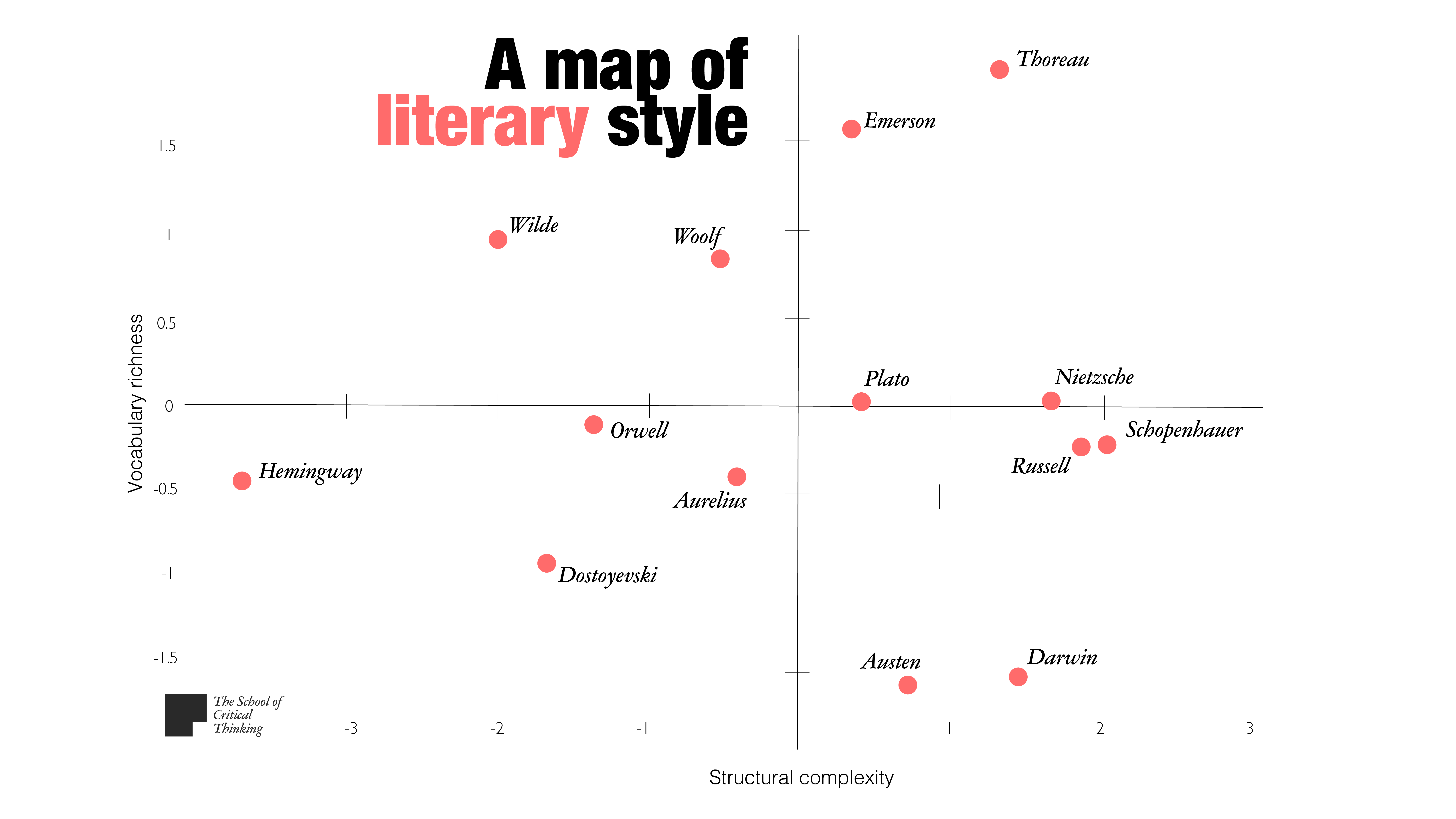
What we see here is a division of authors in four distinct quadrants. In Q1 (the bottom left corner) we have authors with low structural complexity in their writing (think shorter words and sentences) and infrequent use of new words, with Hemingway to the furthest left. But, somewhat similar to him are Dostoyevski, Aurelius, and Orwell — all with an inclination to write with a simpler style and using not too many new words (they are a bit more to the right along the structural complexity axis).
In Q2 (the upper left) are Wilde and Woolf, authors who like introducing many new words, but write simple and short sentences. Q3 (the upper right) contains the hardest authors along both axes: Thoreau leading the group in richness of vocabulary and Schopenhauer in structural complexity. Finally, in Q4 (lower right) are authors who write long sentences using multi-syllable words without too many unique words in their corpus. It is expected to find a scientist there like Darwin, but Jane Austen is close in the neighborhood too.
As you can see, some authors are at the dividing line between two quadrants (like Plato and Nietzsche) or very close to it (like Orwell, Russsell, and Schopenhauer) which makes it harder to classify them neatly, but still — the chart shows us something interesting about them.
What kind of readers authors create
Reading a book is a transformative experience. It’s an act of intellectual conversation (a bit one-sided, though) between a reader and a writer and it’s impossible to escape the writer’s power to imprint ways of speaking and thinking on the reader’s mind.
So, the question about each writer’s style is also a question about what kind of a reader (and thinker) one wants to be. If you want your teenager to develop into a clear, analytical, and coherent thinker (and I think you should want that), don’t jump to the hardest, most complex, and elaborate writer (like Schopenhauer or Thoreau); instead, start at the bottom left quadrant, with writers like Hemingway.
This is my lesson from this little mind (and computation) experiment. It also gives me an explanation of my journey as a reader and a thinker, and provides guidance to what I will recommend my budding teenager read next.
What next?
This article is part of the School of Critical Thinking's curriculum. There are two ways to go deeper.
Free resource
If this article interests you, download a free sample lesson from Seeing Patterns, the first module of the School's curriculum.