What the SHSAT Really Asks Your Child to Read
 Eldar Sarajlic
·
Eldar Sarajlic
·

When parents think about SHSAT prep, they usually think about skills: finding the central idea, solving for x, working with ratios.
But, what gets less attention (undeservedly) is the sheer amount of reading the test requires before any of those skills come into play.
So, how much reading — and what kind — is really required at the SHSAT?
I collected all the tests previously published by the NYC Department of Education and analyzed them: I counted every word in the passages, questions, and question choices — both across ELA and math — and found interesting insights parents and tutors could use.
Here are some of my findings.
How much reading is on the SHSAT?
A typical SHSAT has about 12,100 words of text. Here's where they come from:

The distribution is as most people would expect: each test has about six reading passages, each of them roughly about 800 words long (plus one or two passages for editing/revising).
But, the surprising finding is this: the ELA questions and answer choices contain almost as many words as the passages themselves, because editing questions often include whole paragraphs and many reading questions quote lines from the text. Math adds another 2,350 words, since nearly all SHSAT math questions are word problems.
So, to put 12,100 words in practical terms: the test lasts 180 minutes. How much of that goes to simply reading everything once depends on how fast your child reads.
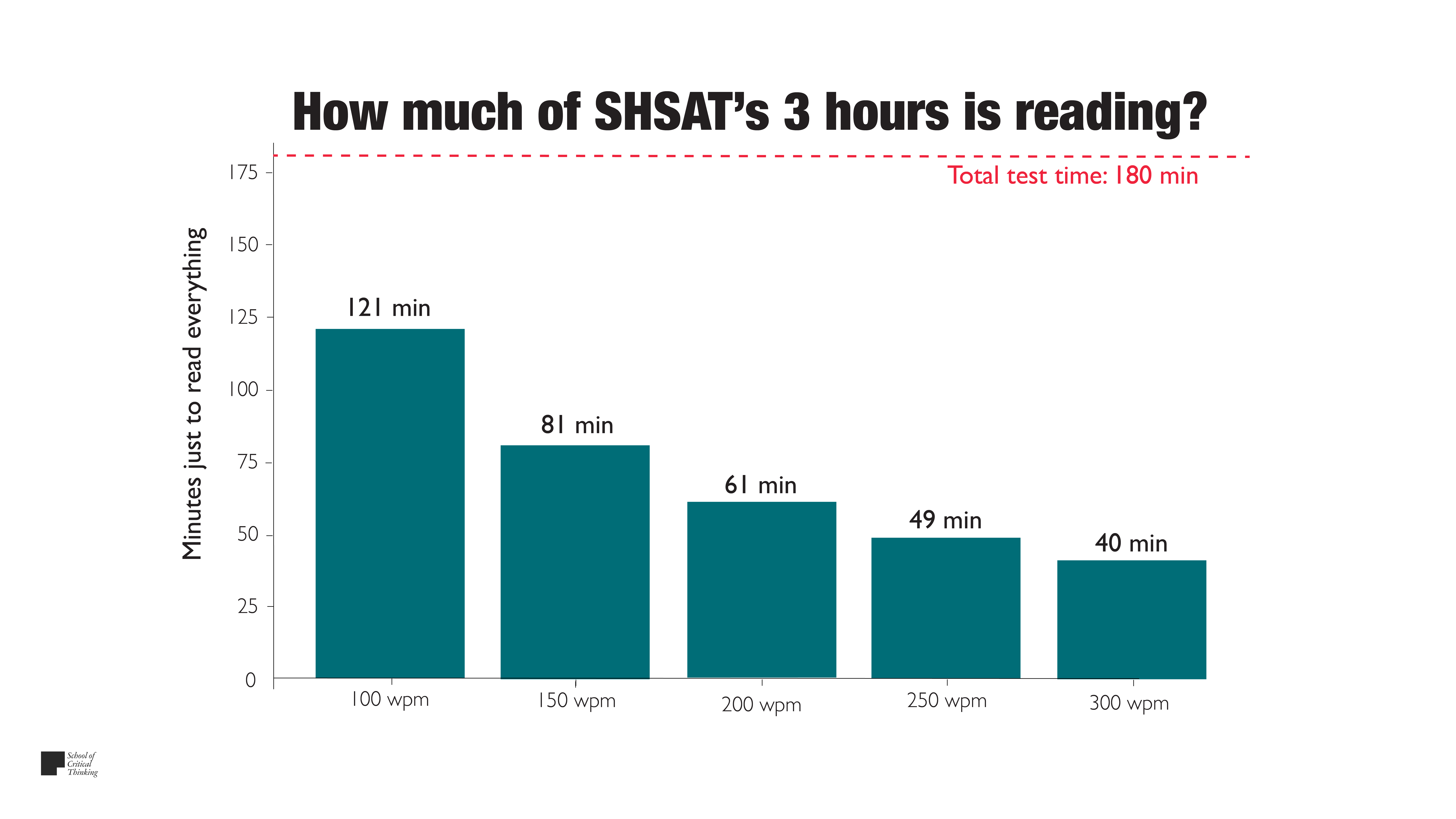
At 100 words per minute (wpm), reading alone takes about two thirds of the test time. At 250 words per minute, it takes about a quarter.
Of course, these are minimums: they cover reading each word once, before any thinking, rereading or calculating. For reference, the difference between reading at 150 and at 200 words per minute is 20 minutes. That’s a lot of time that can be used smartly during the test.
How to measure your child's reading speed:
- Pick a nonfiction book or article at roughly middle-school level.
- Have your child read silently for 3 minutes, at a pace where they understand what they read.
- Count the words they covered (count one full line and multiply by the number of lines).
- Divide by 3. That's their words per minute.
Then find that number on the chart above, and you'll know how much of the test your child will spend just reading.
If you’re not happy with the speed, practice reading more than you’d usually do.
Is memorizing hard vocab a good idea?
A common presumption is that memorizing complex words is a good idea in general. The SHSAT passages often use high-level words — many of which may not be familiar to middle-schoolers — so parents and tutors might use vocab drills to strengthen the student’s vocabulary skills.
I analyzed about 58 distinct reading passages (from the sample tests published over the past 8 years) to see how many rare words occur and what’s their distribution. In total, there were around 618 rare words (from “anemometer”, “numbat”, “stonier”, to “spartina”, for example).
But, what surprised me was that these rare words are not equally distributed across all passages. In fact, more than 90% of the rarest words appeared in just one passage: The Spirit of the Heard.
It’s important to clarify that the rare words usually fall into three kinds of buckets:
- Topic terms (like “bristlecone”, “hieroglyphic”, “samizdat”, “ostraca”, “amasake”). The passages usually explains these in a footnote, and no student is expected to know them in advance (this is exactly why contextual reading skills matter).
- Older literary words, from 19th- and early-20th-century excerpts (”plaintive”, “justly”, “rudiments”, “tapaderos”). These cluster in the classic texts, which are among the top contributors.
- General academic words (”unimpeded”, “irreparable”, “recuperate”, “unresponsive”). These are worth knowing in general, but they still don’t repeat across tests, so the best route to them is wide reading, not a list built from past tests.
What does this mean for a parent or a tutor?
A word list built from past SHSAT passages will mostly contain words that never come back. This has nothing to do with the test being tricky, since rare words behave this way in any collection of texts (for my fellow stats nerds: it’s Zipf’s law at work, since most words in any language are rare, and most rare words show up in only one text).
The practical conclusion is that preparation for passage vocabulary comes from two things: reading widely, so that more words are familiar, and practicing how to work out an unfamiliar word from the sentence around it.
The words that do come back
However, the vocabulary in the questions behaves very differently from the passages. There, a small set of words appears again and again, on nearly every test. "Convey," for example, appears on all 12 official practice tests.
The most surprising finding: nearly half of all SHSAT ELA questions (48%) use at least one of just 11 words.
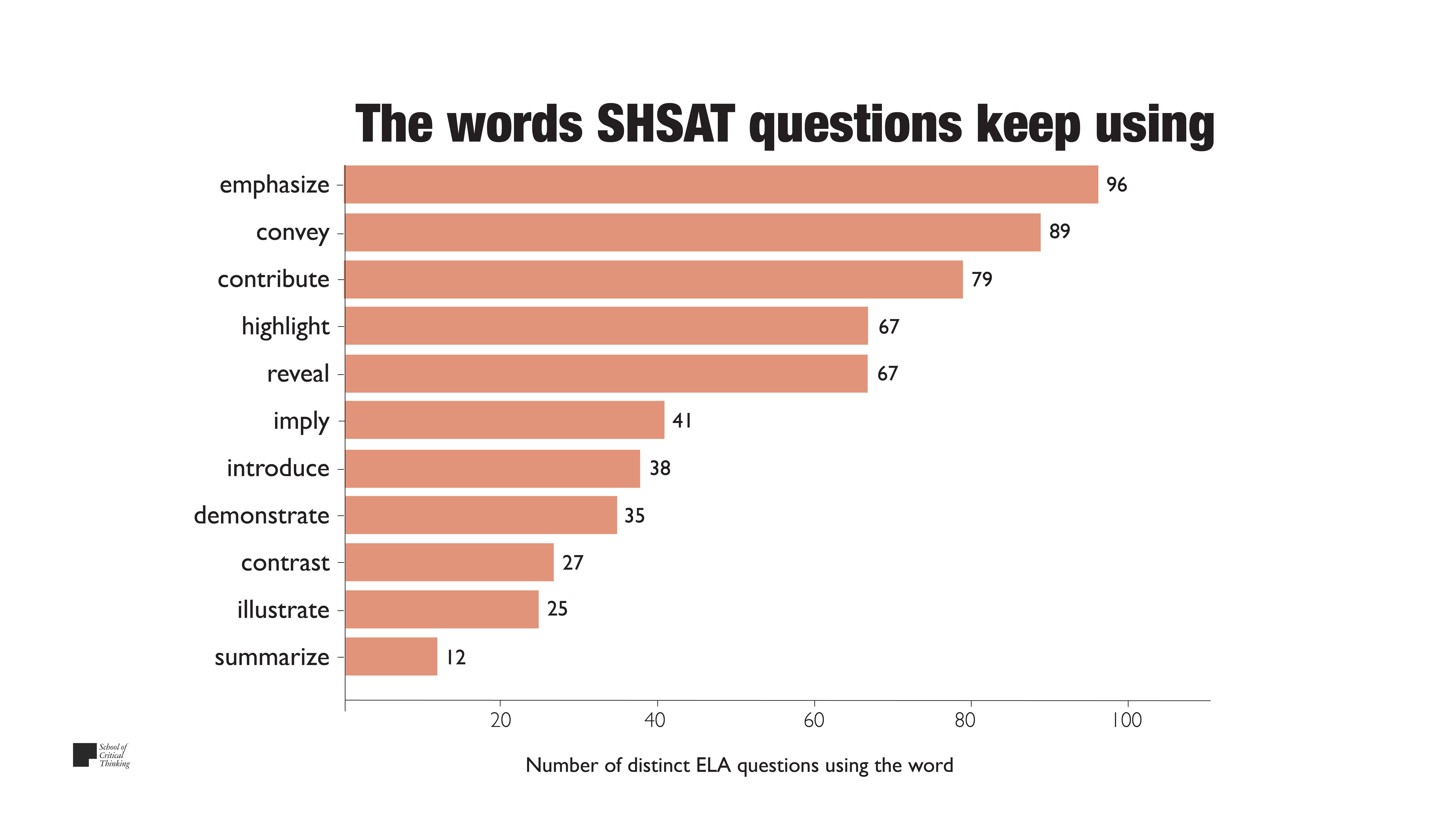
These words tell the student what the question wants. A student who reads a question like "How does the author's word choice emphasize the narrator's frustration?" has to know exactly what "emphasize" asks for before the passage can help.
Math has its own recurring vocabulary, and it's mostly geometry and units of measure: shaded region, parallelogram, radius, perimeter, midpoint, vertex, slant height, integer, repeating decimal.
"Centimeters" alone appears in 23 questions, and converting between metric and customary units comes up often. One detail I found entertaining: the test sometimes invents units ("sinds," "dalts," "plunks") so that students can't rely on memorized conversions and have to reason through the conversion itself.
What to do with this
Parents and tutors have a few actionable things, based on these findings, to do:
- Measure your child's reading speed, now. Use the five-minute test above. It tells you how much of the three hours reading will take, and whether reading speed is the bottleneck.
- Build reading speed early. Speed grows slowly, through months of regular reading, so it belongs at the start of prep rather than in the final weeks. Nonfiction on science, history and nature matches the kind of passages the test uses.
- Skip passage-based word lists. Past passages won't tell you which hard words appear next. Spend that time on wide reading and on practice working out word meanings from context.
- Teach the 11 question words directly. Go through the table above with the student, with one example question for each word. This is a small investment, and it touches nearly half of the ELA section.
- Cover math vocabulary and units. Make sure geometry terms (vertex, radius, slant height, parallelogram) and unit conversions are automatic, so they don't cost time on test day.
- Treat math as reading practice too. Before solving a word problem, have your child say in one sentence what is given and what is being asked.
If you want to establish a precise level of your child’s (or student’s preparedness) for the test, find one that reflects the real sample tests published by the DOE, and don’t rely much on third-party materials (very often they will be too easy).
The practice tests we build at the School of Critical Thinking are designed to match the official SHSAT as closely as the data allows: the same mix of question types, the same reading load, the same kind of question vocabulary, and passages of comparable length and difficulty. A practice test that reads lighter than the real one gives your child a false sense of pace, and one built around the wrong vocabulary trains the wrong habits.
If you’d like to see where your child stands, you can take our Baseline test here for free. You’ll get a detailed breakdown of their errors by question type, and practical feedback you can use to plan the rest of their prep.
Good luck!
Stay sharp
New research and test-prep insights, straight to your inbox.
What next?
Start with a free baseline test. Full exam, full error analysis, no credit card.
SHSAT Prep
Full-length adaptive practice tests reverse-engineered from the official DOE handbooks. Free baseline test with error analysis.
Start SHSAT prep →See the science behind it
How we analyzed over 1,300 questions and five thousand answer choices to figure out what the SHSAT is really made of.
See the method →Free baseline test
100 questions. Full error analysis. No credit card required.
Start the free baseline test →