How to recognize trickiest SHSAT answer traps
 Eldar Sarajlic
·
Eldar Sarajlic
·
All students who have practiced enough using SHSAT sample test know that every SHSAT question has one right answer and three wrong ones.
The good ones also know that the wrong answers are not random: each is built to catch a specific kind of a mistake. This is standard practice in all standardized tests, SHSAT is no different.
What may be different, however, is the type of those traps. What are the most frequent ones in the SHSAT?
I set out to find the answer to this question.
To find out, I went through every wrong answer in the 12 official SHSAT practice tests published by the NYC Department of Education, about 3,900 of them, and tagged each one with the kind of trap it sets. Then I checked those tags independently: the math traps with arithmetic, and the reading traps with machine learning language models that compare each answer choice with the passage.
(For my fellow ML nerds: I used NLI and Transformers to compare answers to each other and to the passage.)
It turns out that a handful of traps do most of the work, and most of them can be spotted with a few simple habits.
Here's what I found.
Three reading traps do most of the damage
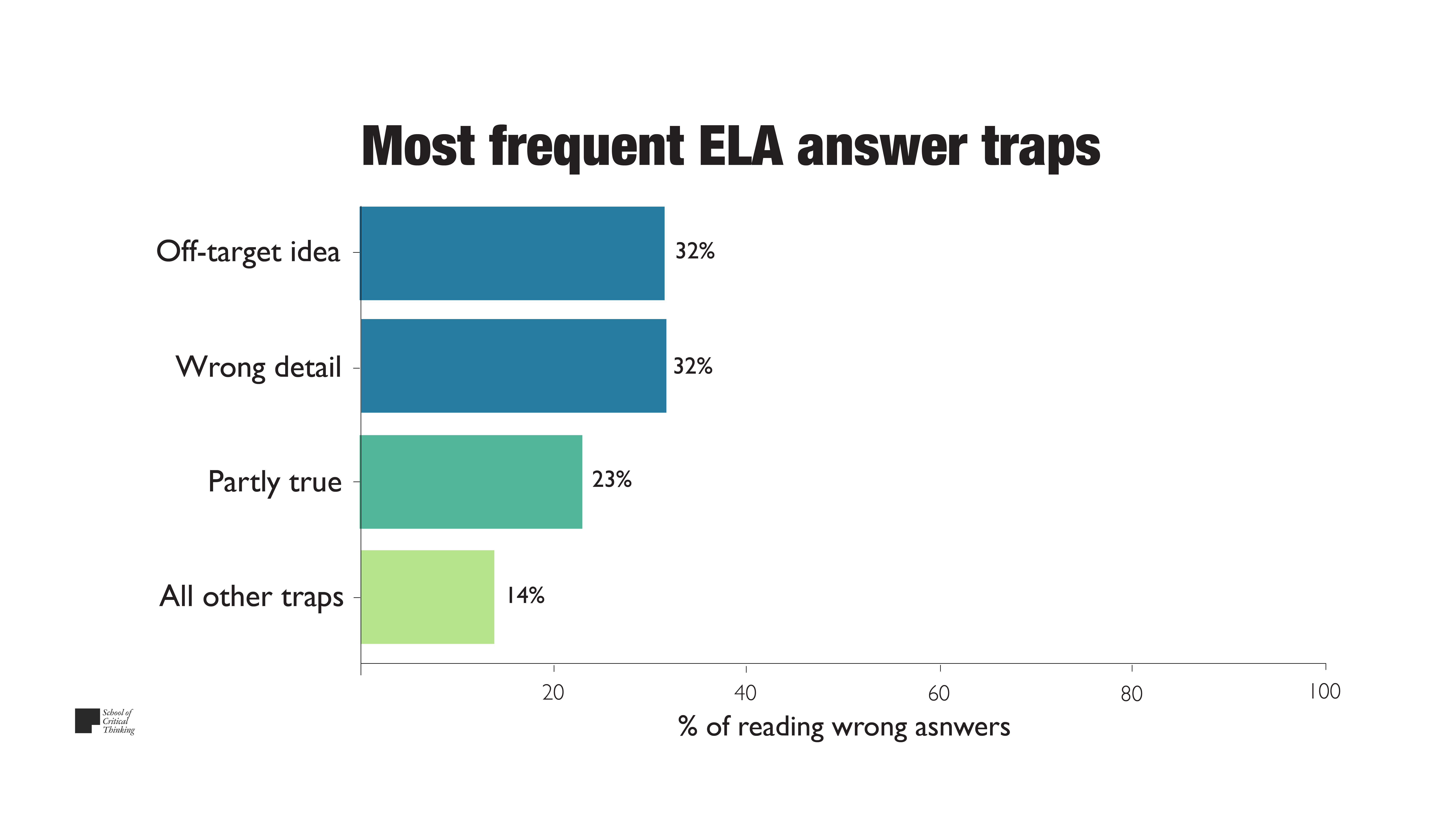
The reading section uses quite a few kinds of wrong answers, but three of them account for about 86% of all wrong answers in reading comprehension:
- The off-target idea (an answer that sounds reasonable but brings in something the passage isn't talking about).
- The wrong detail (an answer choice gives real detail from the passage, but not the one the question asks for).
- The half-truth (an answer that starts right and then goes a step too far, or gets one part wrong).
Here’s their distribution:
If the student can understand these three main traps, most of the work in finding the correct answer will be done. But, there are several other traps to be aware of.
Sometimes, a question will feature an answer choice that will sound almost exactly like the passage (as if it was taken out of it), but it will be wrong: it’s a trap, and a very powerful one. One of the things I measured in my analysis is how closely each answer choice to a question resembles the passage, in wording.
What I found out was a bit surprising, to be honest: in 73% of questions, at least one wrong answer sounded more like the passage than the correct answer did.
Yes, you read that right. In almost two-thirds of the cases, at least one incorrect answer will sound more like the passage than the correct answer.

Why is this so? Well, when you read several of the passages and try to answer some of them yourself, you’ll see that sometimes the correct answers on the SHSAT usually restate the passage's idea in new words, while the wrong-detail and too-narrow traps lift words and phrases straight from the text trying to trick the test-taker by mere wording similarity. So an answer that echoes the passage feels familiar, and that familiarity is exactly what the trap counts on.
I also checked, for every answer, whether there is a sentence in the passage directly backs it up. 43% of correct answers are backed by a single sentence, compared with 27% of wrong answers. So, in slightly less than half of the time, there will be a single sentence in the passage that will directly support one of the answer choices. The tricky thing is that almost a third of the wrong answers will be supported too, which mean that one can’t read the questions too carefully. As usual, the devil is in the details.
There is also one trap is very interesting: some answer choices will go beyond the passage (an inference the text doesn't support) are backed by a sentence from the passage only 5% of the time. This gives students a safe way to rule out these answer choices.

Of course, not every correct answer can be pinned to one sentence (some combine ideas from several), but the gap is clear enough to give students a reliable habit: before choosing, try to find the line in the text that clearly supports it.
Math traps are equally tricky
Math traps are easier to study than reading traps, because numbers can be checked computationally. That’s what I did. For every wrong answer, I tested how it relates to the right answer and to the numbers printed in the problem.
But, this doesn’t mean they are easier to recognize on the test.
One interesting way test-makers try to trick students is by offering them a choice that already appears in the question or in the problem setting. The answer choice might roughly make sense and a hurrying student might choose it to save some time. But, that’s a wrong strategy.
On any multiple-choice question, three of the four choices are wrong, so any given choice has about a 75% chance of being wrong. But when an answer choice is simply a number copied from the problem, it is wrong 87% of the time.
This should be enough to rule that strategy out.

Another interesting way — I’m sorry for finding these things interesting, I’m sure they’re not super fun when you see them on the test — math traps are set up is when the wrong answer choices tempt the test-taker by being predictably distorted twists of the right answer.
I found out that almost 4 in 10 incorrect math answers use the distortion in a recognizable way. For example many wrong answer choices will be:
- off by ×2, ×3 and so on (they will be one step too many or too few);
- close but not equal (they will involve a small calculation slip);
- off by exactly 1 (this is typical of counting problems);
- off by ×10 or ×100 (a decimal will be in the wrong place).
Here’s their distribution:
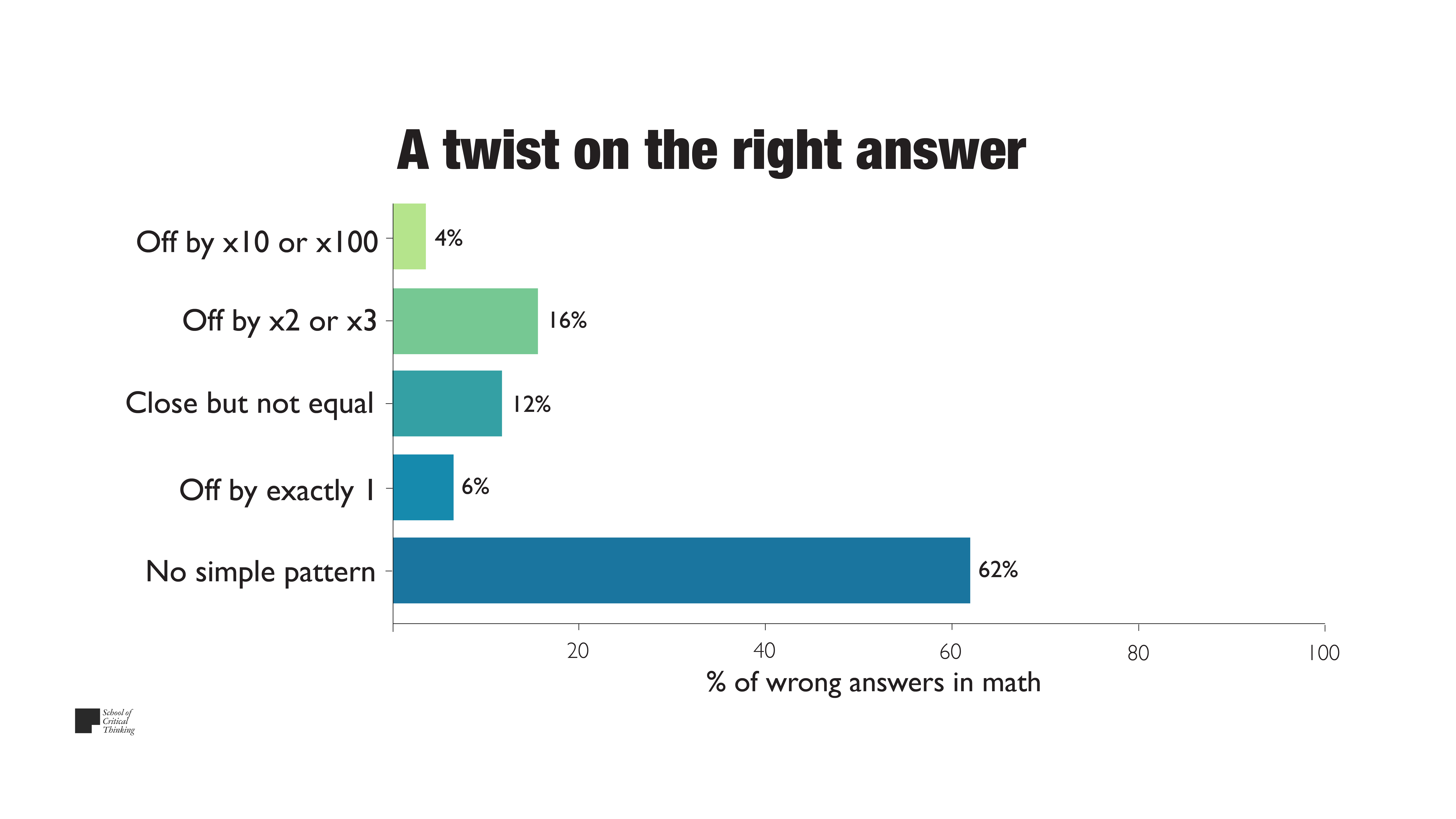
I think this is good news for students, because a quick estimate before calculating can rule out most of the ×10 and ×2 traps immediately. If your child expects an answer "around 50," then 5 and 500 can be quickly recognized as obviously wrong (and quickly ruled out).
Other representative math traps include:
- small slips (small error, usually in in computation or setup);
- stopping a step too early (students not performing the procedure all the way);
- fast pattern match (taking a number from the problem description);
- flipping a ratio (students conflating 2/x with x/2 for example);
- decimal slip (students not being careful about decimal places or units);
Here’s their distribution:
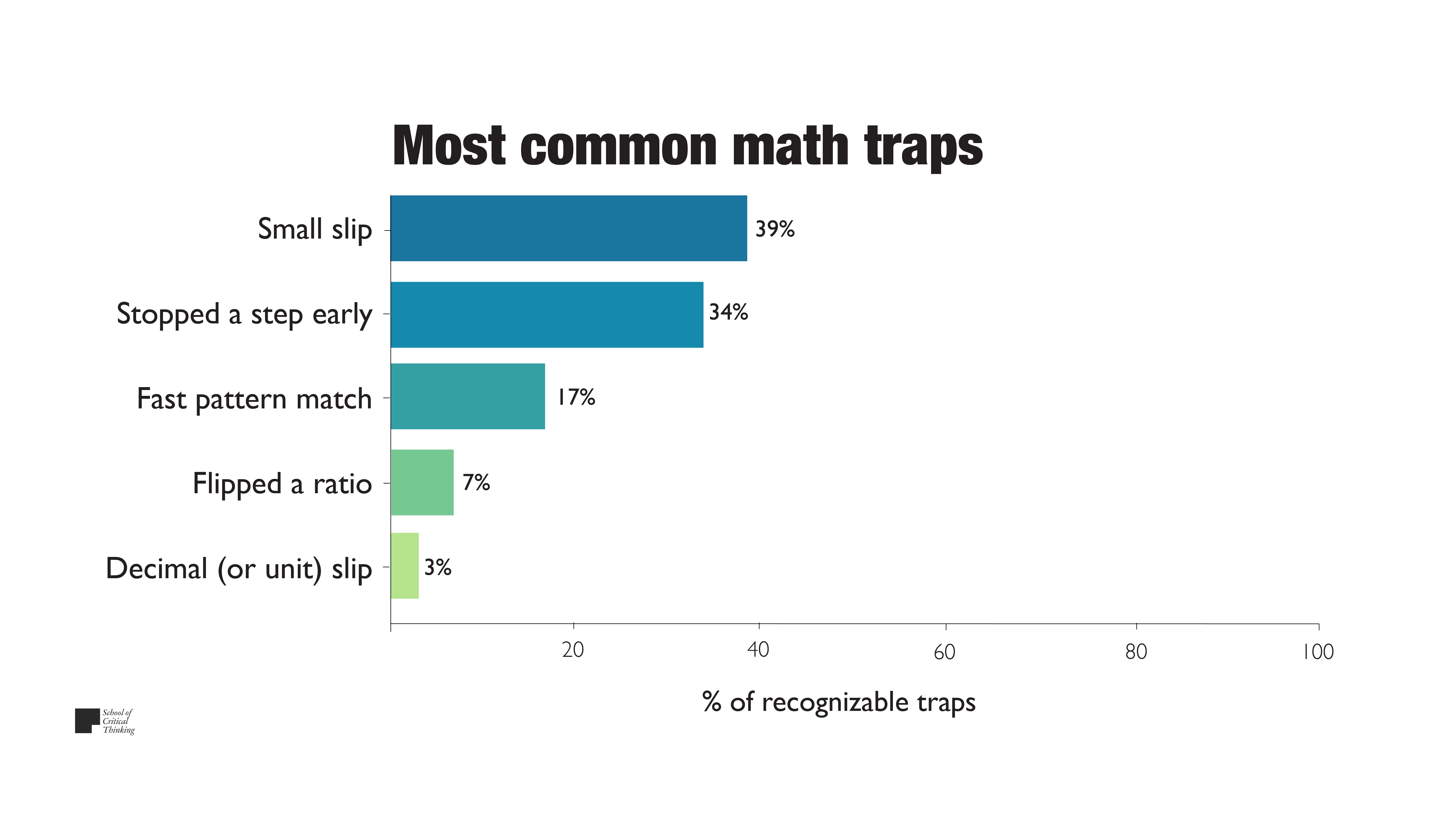
The "stopped a step early" trap deserves special attention. These are answers a student reaches when they solve correctly but stop before the question's last step. The fix is simple: they should re-read the last line of the question before choosing the answer.
The remaining wrong answers come from setting up the problem the wrong way, which no quick check can catch. It’s simply comes down to practice and mathematical acumen.
What to do with this
OK, now that you’ve seen the main ways your kid/student can make a mistake at the SHSAT, what can you do to prevent these from happening?
There are six habits, three for each section, that turn these findings into good prepping practice.
Reading
- Name the three big traps. When reviewing a missed question, ask the student which trap it was: a wrong detail, an off-target idea, or a half-truth. Naming the trap is what builds recognition for next time.
- Distrust the echo. An answer that repeats the passage's wording is not automatically right. The correct answer usually says the same idea in new words.
- Find the line. Before choosing, the student should point to the sentence in the passage that supports the answer. If there’s no line such ine, don’t choose that answer.
Math
- Suspect the copied number. If an answer choice is a number already printed in the problem, check whether the work is actually finished.
- Estimate first. A rough estimate before calculating rules out the choices that are ten times too big or twice what they should be.
- Reread the last line. Before choosing, check that the answer matches what's asked: the total or the part, the change or the cost.
A simple way to practice all six: after each practice test, go through every wrong answer with the student and write down which traps they fell for. After two or three tests, a pattern will show up, and that pattern will tell you exactly what to work on.
Tracking traps by hand works, but it takes time. This is exactly what our practice tests at the School of Critical Thinking do automatically. Every wrong answer in our tests is built around one of these trap types, matched to how often each trap appears in the official DOE tests. After each test, the report shows which traps caught your child, how often, and how many points each one is costing.
If you'd like to see which traps your child falls for, you can take our Baseline test here for free. You'll get a full breakdown of their errors, trap by trap, and practical feedback you can use to plan the rest of their prep.
Good luck!
Stay sharp
New research and test-prep insights, straight to your inbox.
What next?
Start with a free baseline test. Full exam, full error analysis, no credit card.
SHSAT Prep
Full-length adaptive practice tests reverse-engineered from the official DOE handbooks. Free baseline test with error analysis.
Start SHSAT prep →See the science behind it
How we analyzed over 1,300 questions and five thousand answer choices to figure out what the SHSAT is really made of.
See the method →Free baseline test
100 questions. Full error analysis. No credit card required.
Start the free baseline test →