The real cost of SHSAT prep
 Eldar Sarajlic
·
Eldar Sarajlic
·
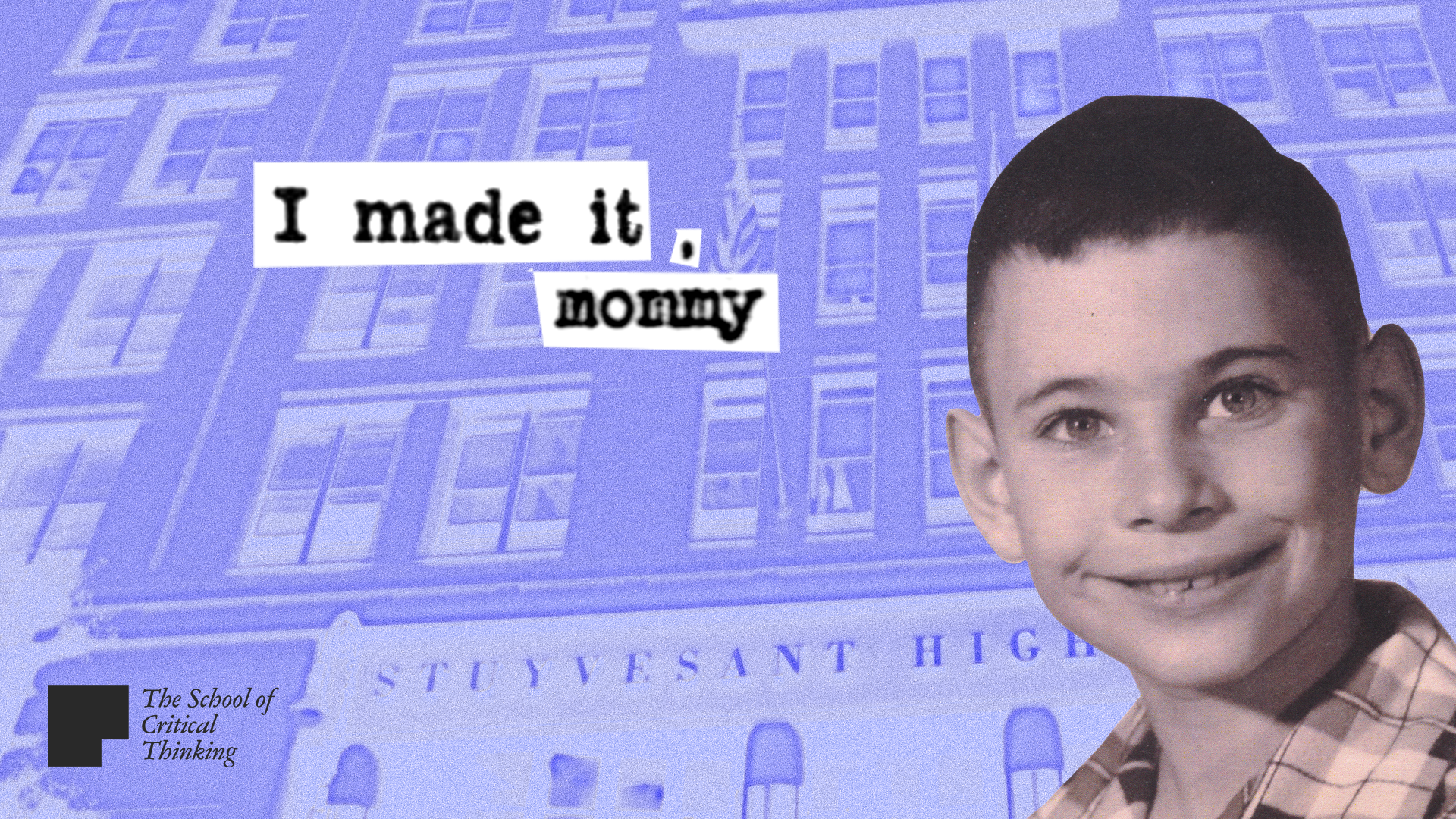
Somewhere in Queens right now, two eleven-year-olds are studying for the same test: the Specialized High School Admission Test, aka SHSAT. One is working through a $22 paperback at the kitchen table. The other has a private tutor who bills more per hour than the plumber who fixed their sink last week.
In eight months both kids will sit for the identical exam, graded on the identical scale, so here is the question every reasonable parent must ask: how much of that enormous cost gap actually shows up in the score?
It's a fair question, and it deserves a careful answer, because the stakes are obviously important. The SHSAT is the single gate to eight of New York City's specialized high schools: Stuyvesant, Bronx Science, Brooklyn Tech, and the rest. Around 29,000 kids take it each year; roughly 5,000 get an offer. The test cuts off a lot of complexity and headache around high-school application. Kids do only one test, on a single day, get a score, and depending on that score, either get an offer from one of the schools, or don't.
As you can tell by sheer numbers, the odds of getting an offer are insanely low. At face value, each child has about 17% to get an offer from any of the schools. If you're aiming at the top of the rung (like Stuyvesant or Bronx Science), chances drop to around 1%.
Faced with odds like that, a loving parent will do the most human thing imaginable: find a tutor or a test prep company, reach for the credit card, and hope that spending more will translate into success.
But is that really the best solution?
So let me do something useful with the next ten minutes. First, I'll lay out what SHSAT prep really costs in 2026, from zero dollars to five figures. Then I'll tell you (using a piece of research from 1984 that most tutoring companies would rather you didn't read) what you're actually paying for as that number climbs. And how to buy the part that matters without buying the parts that don't.
If you have a child prepping to take this test in 2026, these might be the most useful 10 minutes you'll spend thinking about SHSAT.
How much does SHSAT prep cost in 2026?
First, a general overview. SHSAT prep divides into five tiers. They are not five flavors of the same thing; they are five genuinely different products. Here's the range, with representative 2026 pricing.
Look at that table for a minute or two. The span from top to bottom is not a few percent: it's the difference between a paperback and a used car, for the same test. No other purchase in a middle-schooler's life behaves like this. A $12,000 child bicycle is ridiculously overpriced; a $12,000 SHSAT tutor might genuinely be worth it.
But, how can you know?
The full price list: every major provider
Before we get to the "how can you know," here is the "what's out there”: the major SHSAT options in 2026, sorted cheapest to most expensive (some companies don’t put the price out there explicitly, they want you to contact them first).
Add up a season of weekly private sessions and a full program commonly lands between $2,000 and $10,000+, the top of that range being the reason a certain 1984 study called one-on-one tutoring a problem rather than a solution. More on that in a moment.
The free and low-cost options
Before we talk about spending, let's talk about not spending.
The best-kept secret in this whole business is the city's own DREAM–SHSI program, which offers real, structured SHSAT prep for free to eligible 7th graders. It's selective and seats are limited, so it isn't a plan you can count on, but if your child qualifies, it is a serious program that costs you nothing, and it's worth applying the moment the window opens.
Below that, a good practice book (the Tutorverse's 1,200+ Practice Questions runs about $20) plus the free sample questions in the DOE's official handbook will hand a disciplined kid more material than they can finish. Your local library has the rest for the price of a card.
These cheap options share one weakness, and it's the crack the expensive tiers charge you to fill: a book can tell your child that an answer was wrong, but never why. Your kid circles C, flips to the back, sees the answer was B, shrugs, and moves on, very possibly about to make the exact same mistake on the next question, and on test day. The book has no idea what your child was thinking, so it can't correct the thought.
Which brings us to the one thing worth understanding before you spend a dollar on test prep.
The secret behind private tutoring: Bloom's two-sigma problem
In 1984, an educational psychologist named Benjamin Bloom published a paper with a boring title and an interesting finding. He and his students compared three ways of teaching the same material: an ordinary classroom of about thirty kids; a classroom using "mastery learning"; and one-on-one tutoring.
The tutored students, on average, scored two standard deviations above the classroom students, which, in plain English, means the average tutored kid outperformed 98% of the kids taught in a normal class. To illustrate, take a child sitting dead in the middle of the pack and give them a good tutor, and they finish near the top. Same child, same brain, same material. Different method.
Bloom called this "the two-sigma problem” (the Greek letter sigma is a symbol of standard deviation in statistics) because he asked this question: if one-on-one tutoring is this powerful, why doesn't every school just do it? Why don’t schools just replicate this method?
Because a human tutor for every child is wildly, impossibly expensive; it's the $12,000 line in the table above, multiplied by a million kids. Bloom's challenge to the field was to find some scalable method that gets the same result without the same bill.
Now, I'm a professor, so let me add the caveat any responsible scholar would do: later researchers have struggled to reproduce the full two sigmas, so the true effect is probably smaller.
But tutoring remains one of the largest, most reliable effects in the whole of education research, and (this is consequential for your wallet) Bloom's explanation for why it works has held up beautifully. It wasn't the tutor's charisma or their fancy degree. Bloom traced the effect to something much more mechanical: constant feedback and correction. The tutor watches the child try, sees exactly where the reasoning bends, and fixes it on the spot, before the next problem. Test, feedback, correct, repeat. That loop is basically the entire engine; everything else is decoration.
What you're actually paying for: the feedback loop
Once you see that the engine is the feedback loop, the whole pricing table rearranges itself.
That $22 book gives your child zero feedback; an answer key isn't feedback, only a verdict. A group course gives some feedback, but divided across fifteen kids and delivered on Thursday for a mistake made in Tuesday's worksheet; by the time your child hears it, the moment has cooled.
On the other hand, a great private tutor gives the real thing (immediate, specific, aimed at the precise error your child just made) and charges $150 an hour for it, because a human can only sit with one child at a time. As you climb the price ladder, the extra dollars are, more than anything else, buying tighter and faster feedback.
So the question you want to ask yourself isn't "how much should I spend?" It's "how good is the feedback loop I'm getting for my money?"
I think this reframing is genuinely good news for parents, because of what a feedback loop is made of. A tutor's feedback is, at bottom, information: this wrong answer means you misread the question; that one means you set the ratio up upside-down; this trap catches kids who trust the obvious number. Information is the one thing in this world that can be copied and delivered at almost no cost, if (and only if) someone has done the hard scientific work of building it correctly in advance. A dumb app can't do it. An app engineered with the same rigor a good tutor uses can come remarkably close.
That's the whole leverage. The most expensive thing in test prep — the immediate, specific feedback loop that Bloom identified fifty years ago — is the thing that, when done seriously, can hand every child the blueprint for success.
The problem with success rates
If you're a responsible parent (and the fact that you're reading this suggests you are) you might have probably at some point thought of finding the tutoring company with the best track record and signing up your child for classes there. It's a reasonable instinct (I had it too), but it walks straight into the oldest trap in statistics.
If you browse their websites and catalogues, every tutoring company advertises the same kind of number. "Ninety percent of our students got an offer." "Our kids score well above the cutoff." "Hundreds of our students admitted to specialized high schools, and counting." Big numbers, bigger fonts, and always the same implied promise: pay us, and your child joins that percentage. However, the trouble is that the number tells you almost nothing about what the tutoring actually did.
To understand the problem, let's do what all good statisticians do. Think about who signs up for a $4,000 SHSAT course. Do you think this group of people is a random slice of New York's eleven-year-olds? Of course not. The families who write that check are, on average, more affluent, more obsessed with school, more able to sit beside their kid at nine at night helping with homework, and their children were already, on average, more likely to get an offer before a single lesson began. A company that enrolls strong, supported kids and then reports that many of them succeed has told you who walked in the door, not what happened inside it. It's called selection bias and it fools even the smartest among us.
For example, picture a tennis academy that only accepts players who already have a strong forehand, and then advertises that 90% of its students end up playing at the US Open. Did the academy build those players, or simply pick those who already have a great likelihood of success? How do you know what's exactly the effect of their training, isolated from other effects on the players' success?
In addition, you're seeing only the flattering half, but not the remainder (this is another fallacy, called survivor's bias). The brochure shows the kids who got into Stuyvesant; it never shows the equally-tutored, equally-expensive kids who didn't, because disappointment makes a poor testimonial. Some companies even screen at the door, they turn away the applicants who'd drag the average down, or counsel them out after a cold diagnostic, which lifts the success rate without a single lesson teaching anything. And when a company brags that most of its responding families landed a top-choice school, weigh that word: the families whose kids didn't get in are also the families who stop answering the alumni survey.
What you actually want to know can't be read off any of these numbers: would this child — your child — do better with this prep than without it? To answer that honestly you'd have to clone your child (perhaps having identical twins would do as well), send one to tutoring and leave one at home, and compare their success at the test. Of course, no responsible parent would do that. The fact is that there is no control group in a brochure, and there never will be, because the honest comparison would almost certainly deflate the headline of most tutoring centers.
So the offer rate on the banner can't answer the only question that matters, which returns us, one last time, to the mechanism. You can't inspect another family's counterfactual, but you can inspect how a program actually teaches: whether it closes the feedback loop or merely sells you hours of practice. That much you can check before you pay a cent.
How is the School of Critical Thinking different
The School of Critical Thinking, a small organization I built around the idea that all kids deserve development of their critical thinking skills, approaches the problem of test prep differently. We don't boast about numbers or offer exorbitant private tutoring sessions. Instead, we strike at the core of what matters: the scientific rigor of representing the test, and quality of the feedback.
First, I want to be fully honest with you: since DOE never shares any information about how they construct the SHSAT, any test prep book is essentially guessing at what the test actually aims for. Nobody will admit that, but it's the truth. Nobody, except DOE employees, knows exactly what's behind each year's test set. That includes us.
So, how did we construct our own tests?
We used a method called Standardized Test Analytics and Reporting (STAR) that employs statistical and NLP (Natural Language Processing) techniques to understand and mimic the exact nature of the SHSAT, both at the level of each question, as well as the entire test. In a nutshell, our SHSAT platform was reverse-engineered from the official DOE materials using scientific methodology, and it's designed around that one principle: manufacture the feedback loop. When your child gets a question wrong, the platform doesn't flash a red X and move on. It names the specific trap that caught them (we've mapped 28 of them across the test) and the exact reasoning error underneath it, the way a rigorous tutor would if one were sitting beside them. Our tests adapt, and the error analysis reports which traps keep catching your child and which skills are costing the most points. It's the mastery loop — test, feedback, correct, repeat — built into the machine.
And the baseline test is free. A full 114 questions with the complete error analysis, no charge, because you shouldn't have to pay anyone before you even know where your child actually stands.
Let me also tell you what software can't do, since anyone who claims otherwise is selling you snake oil. A screen can't notice that your kid is anxious, or bored, or brilliant-but-lazy in a way that needs a human to recognize. It can't build the relationship that makes a discouraged twelve-year-old try one more time. If your family can afford a great tutor and your child needs that human push, buy it — it's definitely worth it (the two-sigma problem is clear about that). But most families can't spend $8,000. So, the sane strategy for almost everyone is this: get the feedback loop cheaply, where a machine can deliver it adequately, and spend your scarce human-tutoring dollars only on the things a machine genuinely can't touch.
You can start the free baseline today (here: schoolofcriticalthinking.org/shsat) and see exactly which traps are catching your child. That costs you nothing but the honesty of finding out.
Frequently asked questions
How much does SHSAT prep cost? Anywhere from $0 to more than $10,000. Free DOE programs and library books sit at one end; a full private-tutoring program sits at the other. Most families land somewhere between a $25 practice book and a $1,300–$3,100 group course.
Is SHSAT prep worth it? The SHSAT is the sole admissions criterion for eight specialized high schools, so preparation clearly helps. But the return comes from the quality of feedback your child gets while preparing, not from the size of the bill.
Can I trust a tutoring company's advertised success rate? Be skeptical. The families who buy expensive prep are already more likely to succeed, so a high offer rate mostly reflects who enrolled, not what the teaching added, and the kids who didn't get in rarely appear in the marketing. Judge the method, not the billboard.
Is free SHSAT prep good enough? For a disciplined student, free resources plus a solid practice-question bank go a surprisingly long way. The piece they almost always lack is feedback; a way to learn why an answer was wrong. Fill that gap and free prep becomes genuinely competitive.
How many hours of SHSAT prep does a child need? There's no magic number. Six to nine months of consistent practice with real error analysis will beat a last-minute cram of twice the hours, because mastery comes from correcting mistakes, not from logging time.
What's the most cost-effective SHSAT prep? Buy the feedback loop cheaply, like a rigorous adaptive platform, or a practice bank with genuine explanations, and reserve expensive human tutoring for the specific gaps a machine can't address.
If you take one thing from all this, let it be the reframing, not the price list. Prices change; the principle doesn't. You aren't paying for hours, and you aren't paying for a brand name; you're paying for the speed and precision of the feedback your child gets when they're wrong, because being wrong and finding out exactly why, fast, is the whole of how anyone learns anything. Start there, spend outward from there, and you'll be paying for the score instead of the sticker.
Sources: NYC DOE — Specialized High Schools and the DREAM–SHSI program (schools.nyc.gov); Khan's Tutorial, Kweller Prep, Caddell Prep, TestPrepSHSAT, Testing Mom, The Tutorverse, Bobby-Tariq, GeniusPrep, Ivy Tutors Network, NYCTutoring.com, and Wyzant published rates; Benjamin S. Bloom, "The 2 Sigma Problem," Educational Researcher (1984). 2026 prices are estimates and change often — verify before deciding.
Stay sharp
New research and test-prep insights, straight to your inbox.
What next?
Start with a free baseline test. Full exam, full error analysis, no credit card.
SHSAT Prep
Full-length adaptive practice tests reverse-engineered from the official DOE handbooks. Free baseline test with error analysis.
Start SHSAT prep →See the science behind it
How we analyzed over 1,300 questions and five thousand answer choices to figure out what the SHSAT is really made of.
See the method →Free baseline test
100 questions. Full error analysis. No credit card required.
Start the free baseline test →