What the Hunter exam really tests
 Eldar Sarajlic
·

Every January, a few thousand New York City sixth graders sit down for one of the most selective entrance exams in the country: Hunter College High School test.
It’s understandable why many parents have their middle schoolers try for the test: if successful, they kids will complete their middle and high school at one of the finest public schools in the city. They’ll be set until college.
But, how hard is to get a spot in Hunter High?
Extremely hard. Check it out:
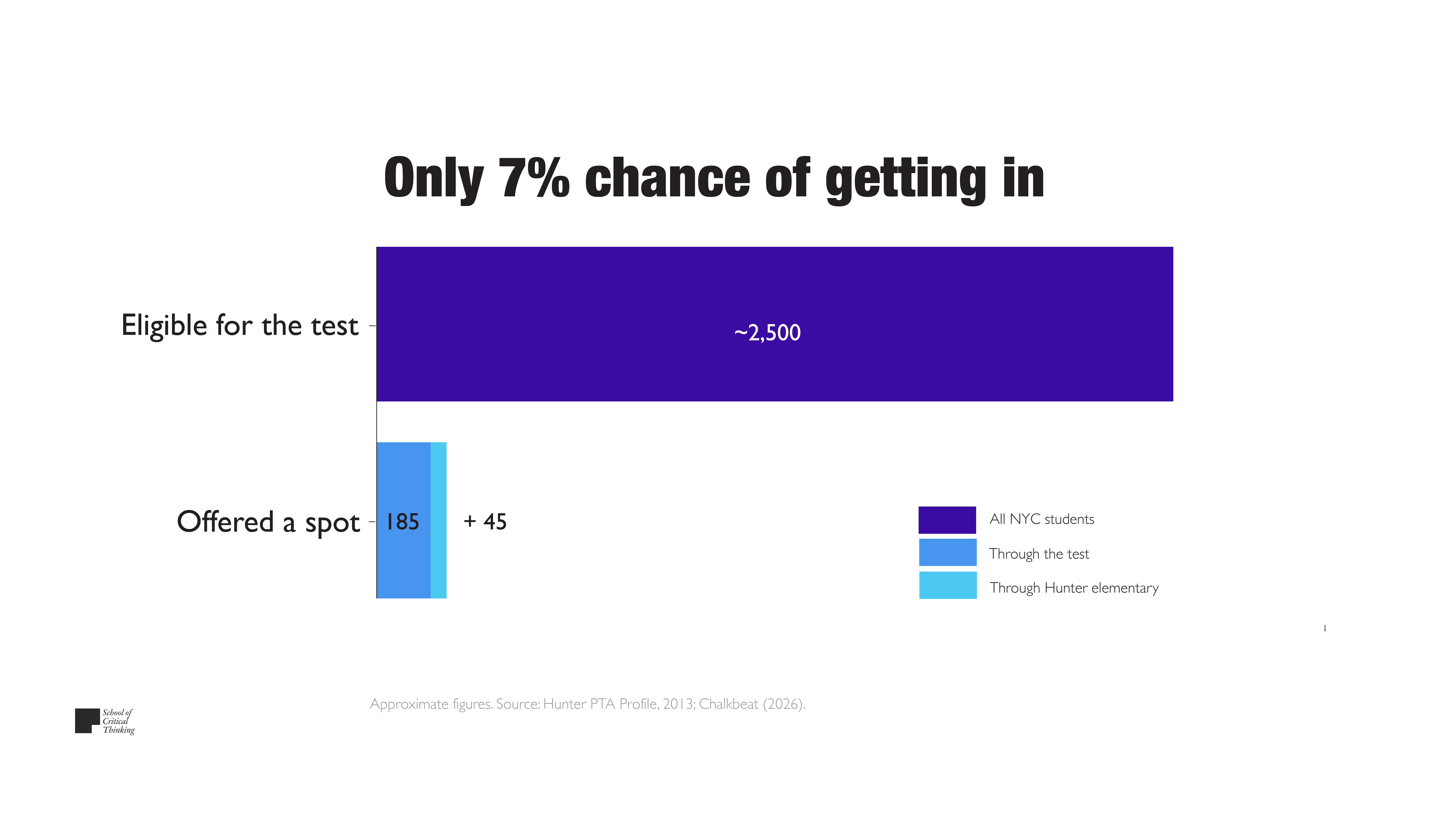
The school admits a tiny fraction of eligible students. Out of around 65,000 middle schoolers in NYC, approximately 2,500 are eligible through their state test scores. If we assume that most of them actually take the test, then the chances of getting a spot are around 7% for each individual kid.
Now, of course, these chances are not random. They depend (heavily, one might say) upon how the families prepare for the test.
But, prepare for what exactly?
Most families (and test prep centers) answer that question with a stack of practice tests and a vague sense that the exam is "hard."
Yes, it is hard, but I wanted a more precise answer. Hard in what way?
So, I took every official sample question Hunter has released for the current version of the exam, 187 multiple-choice questions plus the writing prompts, and reverse-engineered them down one by one: what skill each question tests, how difficult it is, and what kind of thinking it demands. I used statistics, machine learning, and natural language processing to derive as much insight as I could from these sample tests.
The picture that came out of this analysis is clear (and in a few places it runs against what most families assume).
Here's what the Hunter exam is made of, and what that means for how your child should spend their prep time.
The test in a nutshell
The exam changed recently. In 2024, Hunter's test had 45 English questions and only 30 math questions.
The January 2026 exam looks very different:
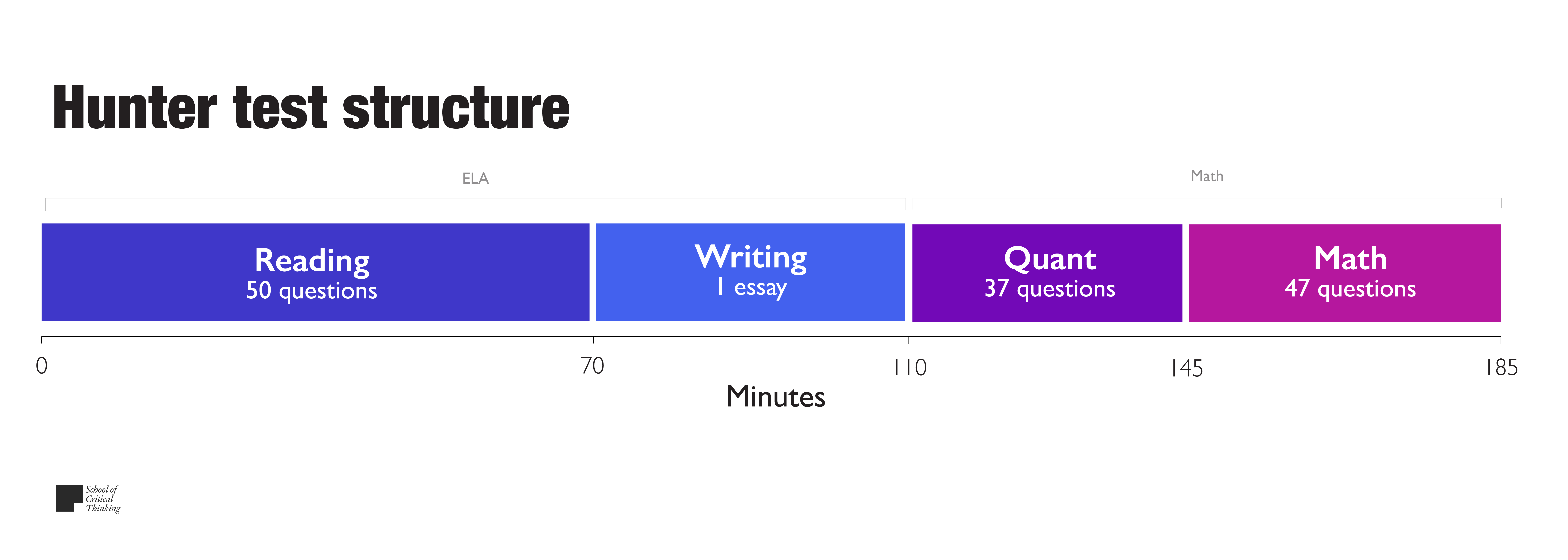
The test consists of an ELA section — with 50 multiple choice questions and an essay — and a math section divided in two, Quantitative Reasoning and Math Achievement.
The whole exam runs 185 minutes. Two changes are most important in the new test:
- Math nearly tripled, from 30 questions to 84, and now outnumbers reading.
- The math now comes from the ISEE, the Independent School Entrance Exam (ISEE) used by private schools, at its Middle Level.
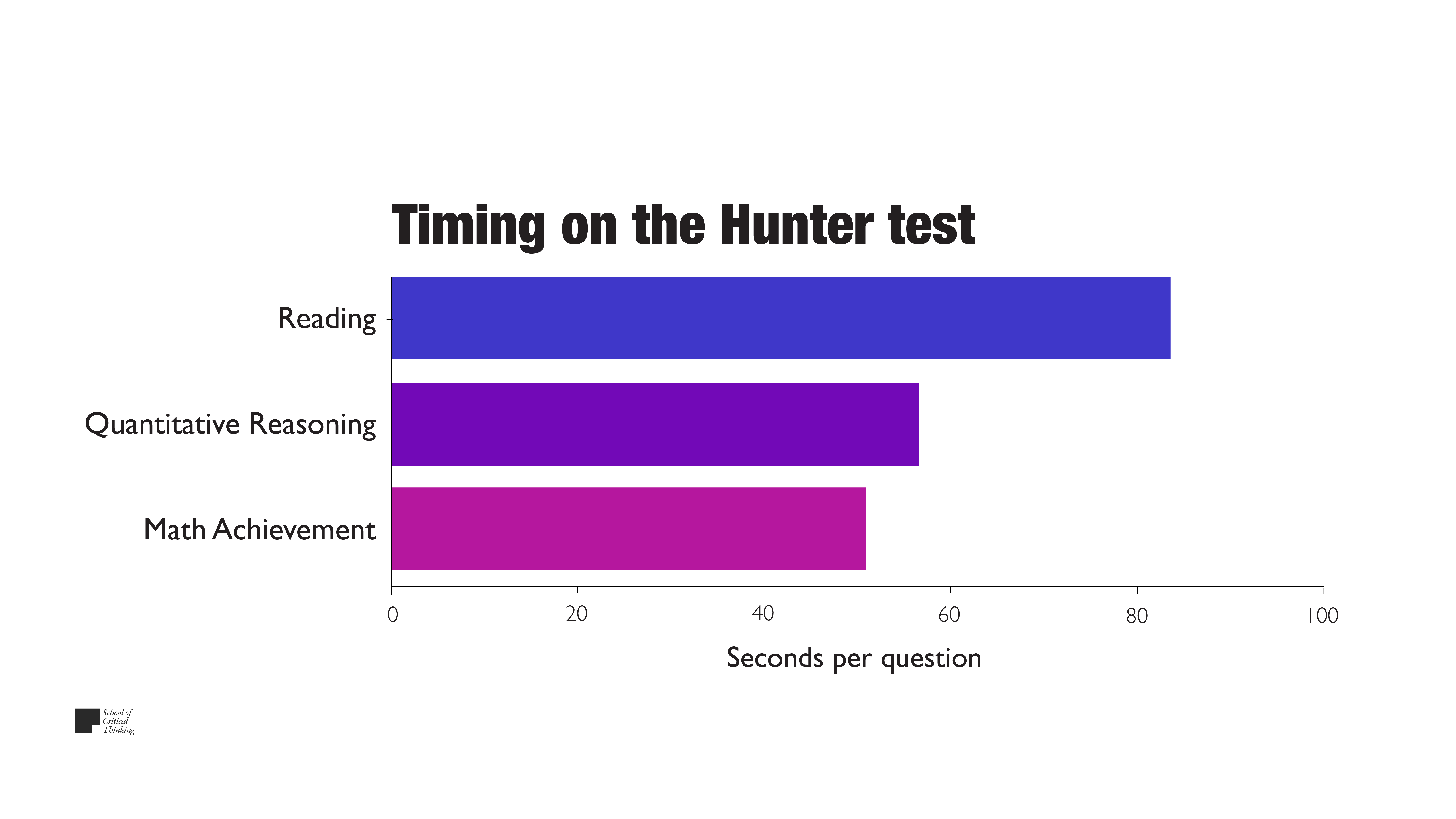
You may think that three hours are enough to complete the test to the best of your child’s abilities, but with this many questions the truth is a bit further than that. When we look at how much time per each question a student will have, the picture is very serious: for each of the two math sections, students have less than a minute per question.
If your child does well on these three sections, only then their essay will be read and evaluated. So, to get to that stage, they need to manage their time extremely well.
But, how to do that?
What follows in the rest of this article might help. I’ll show you what’s under the hood in each section of the test, so you know what to focus on.
We’ll start with ELA.
Reading: a test of what's left unsaid
The 97 sample reading questions indicate an uneven spread of reading skills. My analysis showed that just three skills carry three quarters of the ELA section:
- Inference: what the text implies but never states. Questions of the type: "The narrator's remark suggests that…"
- Word meaning in context: what a word means in this particular sentence. For example, "As used in line 7, doggedly means…"
- Figurative language: what an image or comparison is doing.
It is very interesting to notice what is almost missing. Main idea, structure and point of view, the bread and butter of most school reading instruction, account for only 7 of 97 questions. Which means that your school will not prepare your child well for this test: you need extra help.
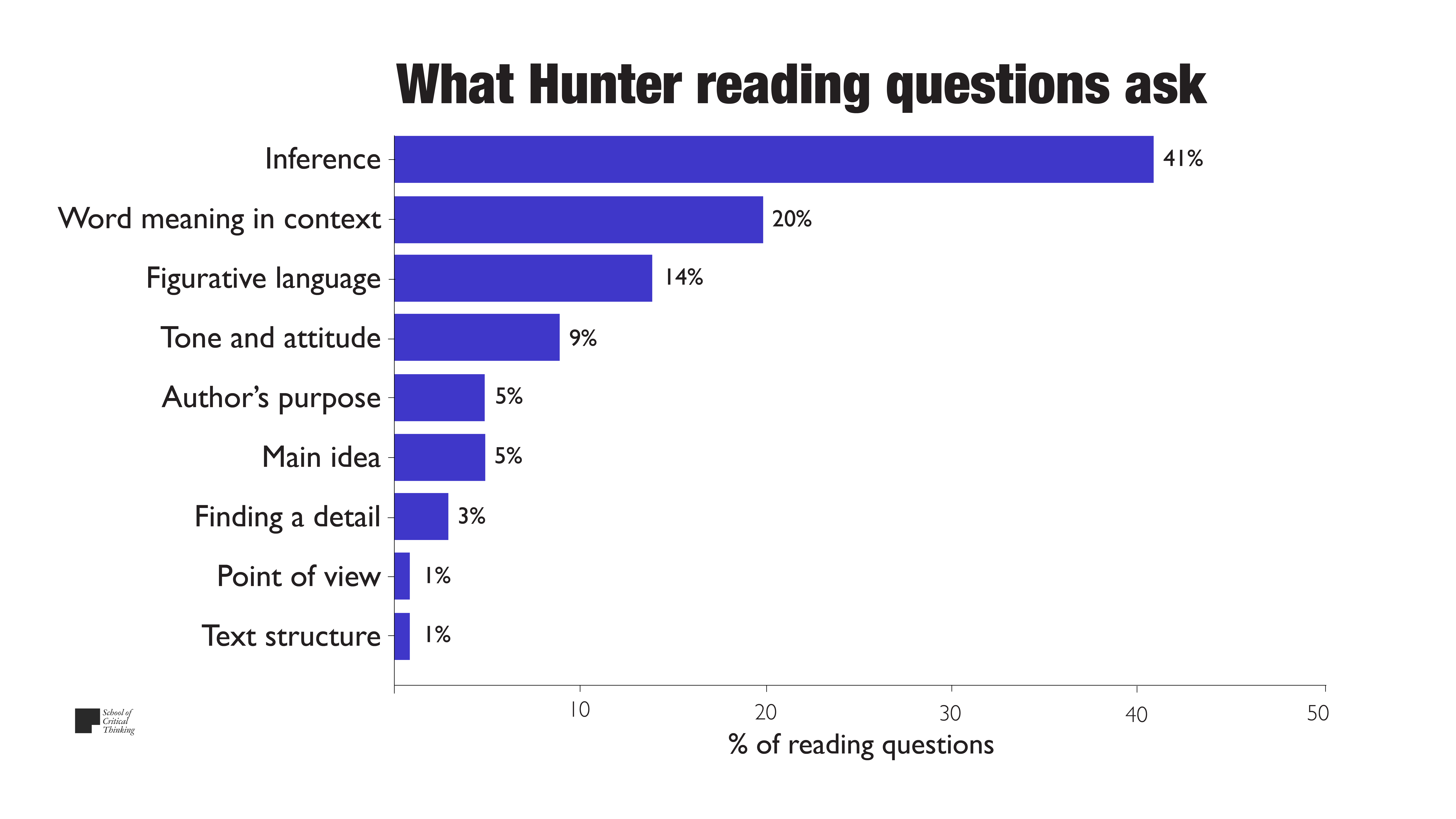
What is also clear from this is that Hunter test isn't really asking student simple questions like "what is this passage about?" Much more than that, it is checking for inferential skills: what does this passage mean without saying it? Those are different skills, and they require different kind of preparation.
How often a skill appears on the test is only a half of the story, however. The other half is difficulty: how hard are the questions testing each of these skills?
Here’s what my analysis showed:
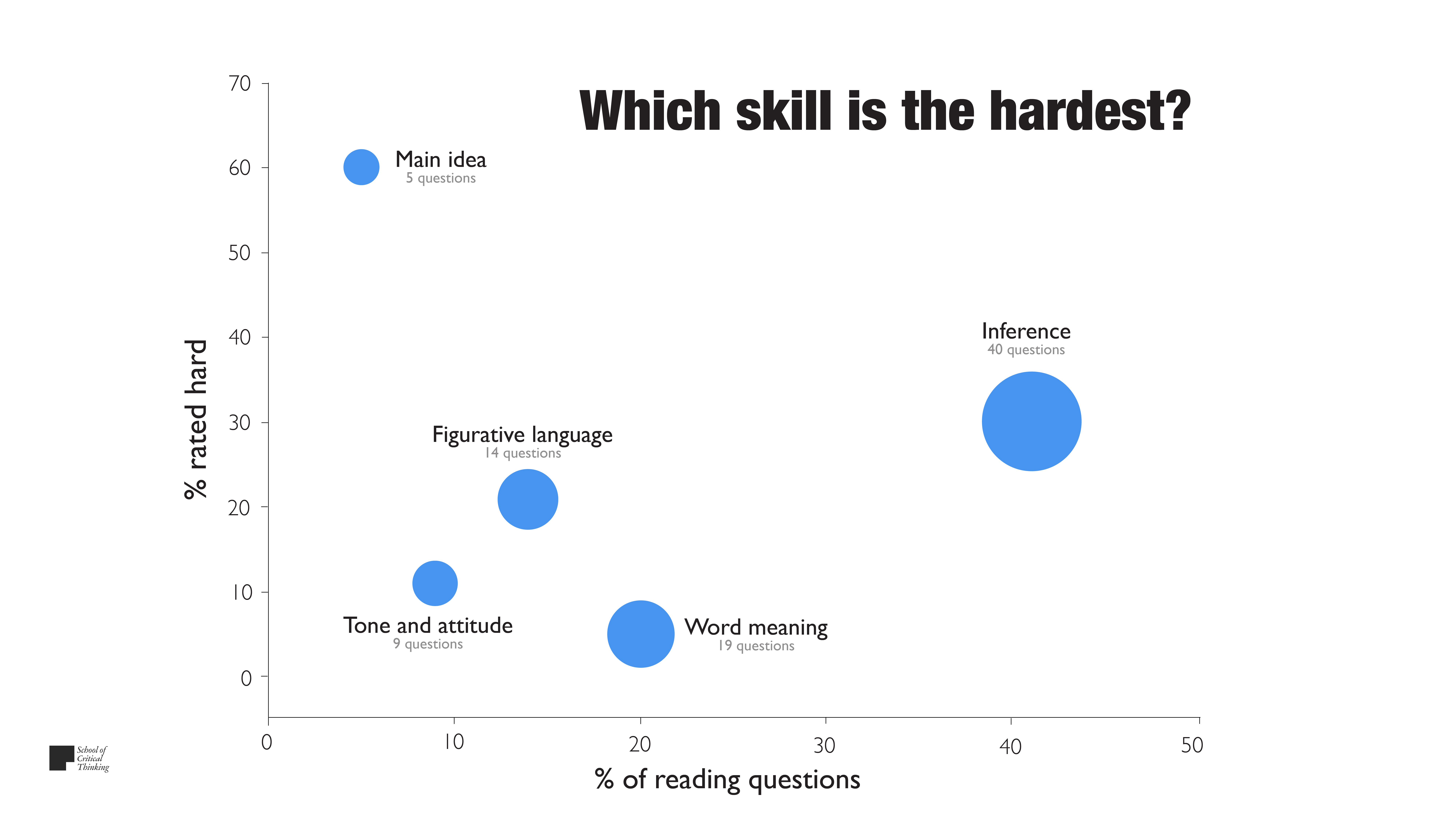
Three things are worth pointing out here:
- Inference is the center of gravity. It's the most common skill and one of the hardest: 12 of the 25 hard reading questions are inference questions, more than every other skill combined.
- Word-meaning questions are frequent but rarely hard. These are points a well-prepared child should almost never lose.
- Main idea and author's purpose are rare but often hard. With only five questions each, I'd treat that as a strong hint rather than a law, but it's worth a few practice sessions.
Math: two sections, two different tests
The 90 math sample questions cover six areas, but three of them account for about two thirds of the questions: algebra (23 questions), data and probability (19), and fractions, decimals and percents (17).
Algebra being the largest area may surprise some parents of sixth graders. But, it's early algebra: patterns, rates, simple equations, reading a slope off a graph; it's the biggest single block.
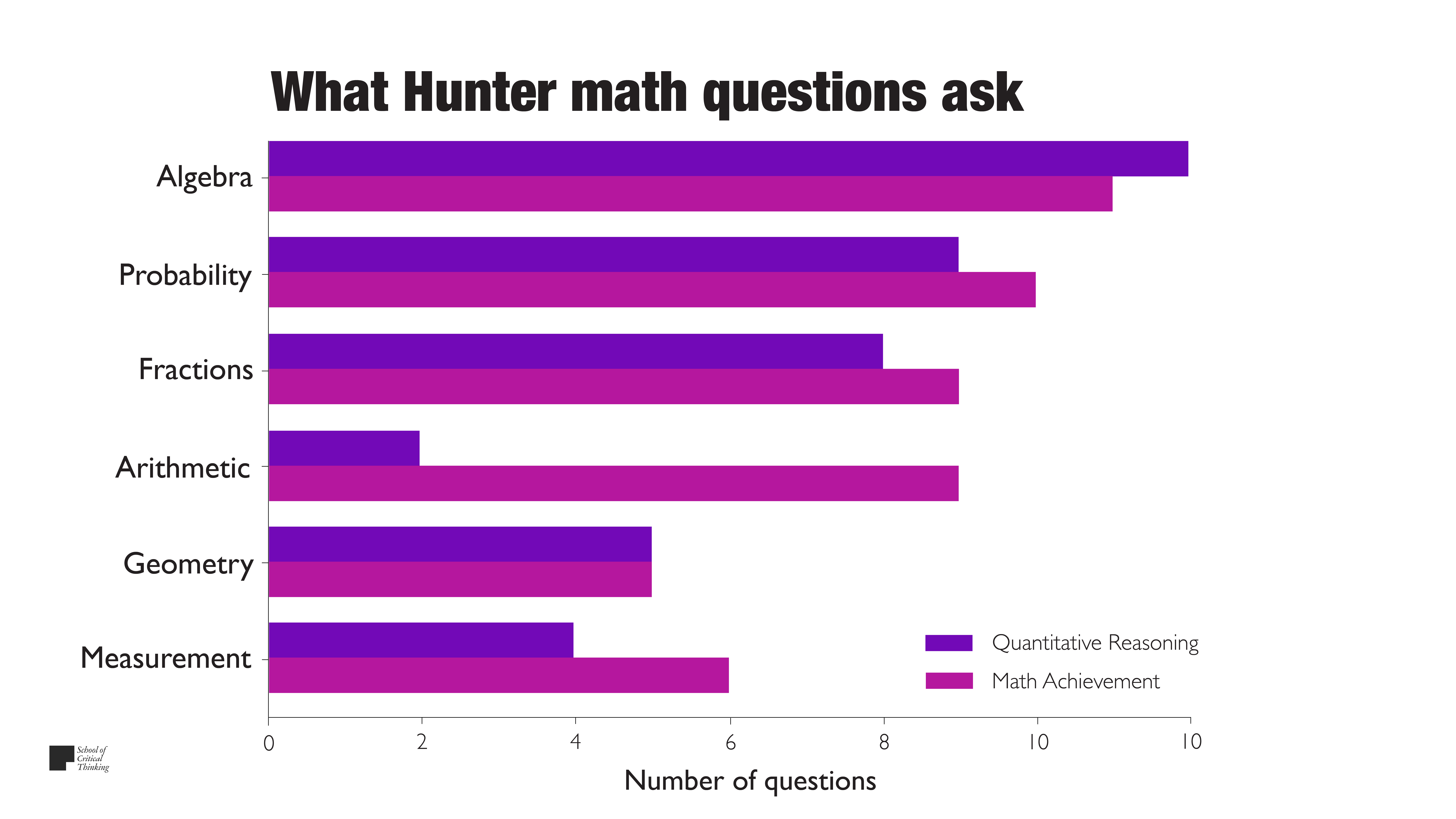
A legitimate question any parent may ask is: why is math tested with two separate sections? What do Quantitative Reasoning and Math Achievement ask differently (if at all)?
The difference between the two comes from the ISEE standards. It is made by an independent testing non-profit organization (called Educational Records Bureau, or ERB) and their standards have five parts, but Hunter only uses these two for math.
Basically, the two math sections do test different things, even when the topics overlap. Mathematics Achievement checks that a skill is there. For example, "Which expression is equal to 20?" followed by four ways of placing parentheses. This is a direct test of order of operations, a skill students should have under their belts by 6th grade.
On the other hand, Quantitative Reasoning checks whether a child can use that skill properly. For example, a typical question will give an invented exchange rate (1 coin equals 2 stamps; 3 chips equal 2 coins) and ask what 12 chips are worth in stamps. The arithmetic is just as simple, but the child has to chain two conversions in the right direction. It’s more a modeling than computing task.
Quantitative Reasoning also has a format most children have never seen: 18 of its 40 sample questions are comparisons. For instance, the child is shown two quantities, Column A and Column B, and has to decide which is greater, whether they're equal, or whether the information isn't enough to tell. This isn't harder math, but just an unfamiliar way of asking an ordinary math question.
How difficult is Hunter test?
In testing science, one of the most important concepts is the one called discrimination. Basically, it is the ability of a question to distinguish between good and bad students. If a question is at a sufficient level of difficulty, only good and prepared students will answer it correctly; others will fail.
This approach is in the background of the Item Response Theory, the prevalent testing theory that helps test-makers create adaptive tests that successfully identify smart and well-prepared students. This means that if your child answers these questions correctly, they will score higher on the test.
Although every question on the Hunter test will matter, some will be more discriminating than others: meaning they will be much harder.
So I asked a simple question: where do these hard questions live?
Here’s what I found:
- Around 25% of Reading can be considered hard.
- Quantitative Reasoning has 15%.
- Mathematics Achievement has none. Not one of its 50 sample questions seem hard, and more than a third are actually pretty easy.
Scaled to the real exam, that means reading contains about 80% of the hard questions on the test.
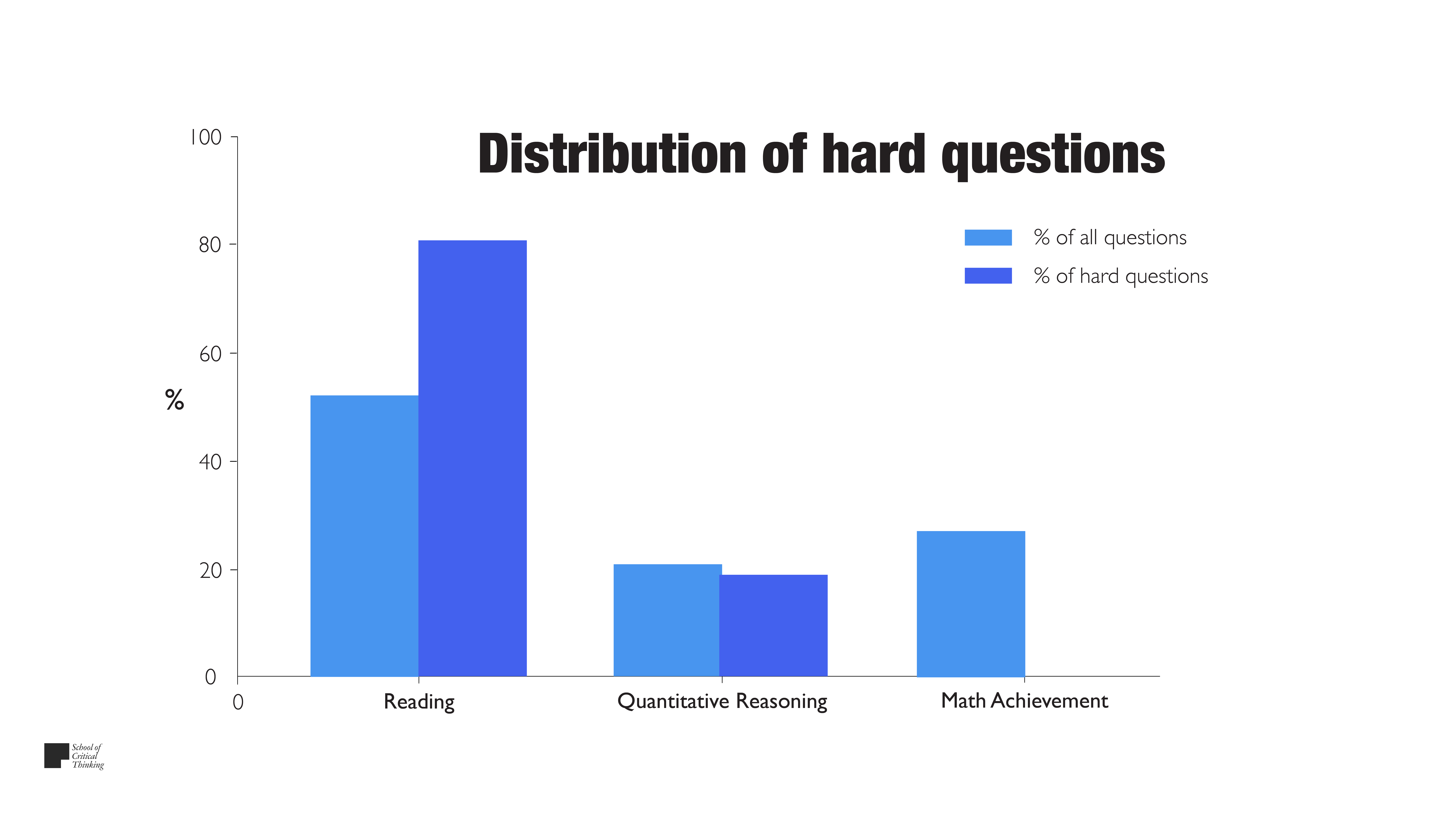
I think this is a very useful finding. I’ll unpack the reading section in more details in the next article.
There's a second way to see the same pattern: the kind of thinking each section asks for. Education researchers use a scale called Depth of Knowledge, which rates each question by what it demands: recalling a fact, applying a skill, or reasoning and interpreting.
Here’s where Hunter test falls on this scale:

As you can see, almost nothing on this exam is pure recall. Memorized facts and formulas will get a child through very little of it.
But also, Quantitative Reasoning looks much more like reading than like Mathematics Achievement: six in ten questions in both reading and Quantitative Reasoning require reasoning, against two in ten in Mathematics Achievement.
That explains a pattern many tutors see. A child who is excellent at math drills can find Quantitative Reasoning surprisingly hard, because it demands the same kind of thinking as reading: holding several pieces of information together and drawing a conclusion the question doesn't hand you on a plate.
What this means for prep
This was a long article, and I get if it feels overwhelming. Let’s summarize.
Put together, the data points to a clear plan. Here’s what I think are the main takeaways:
- Make reading inference the center of prep. It's the most common reading skill and the biggest single source of hard questions on the whole exam. Practice it directly: after reading a paragraph, ask your child "what does this tell us that the author never says?" and make them point to the words that support the answer.
- Read the kind of texts Hunter uses. The sample passages lean heavily on classic literature and poetry. Regular reading of older fiction and poems, out loud and discussed, builds exactly the skills the test rewards. (The next article in this series looks at the passages in detail.)
- Treat Mathematics Achievement as a precision test. No hard questions, under a minute each. The goal there is to stop losing easy points to careless errors, which means timed practice and checking work, not harder problems.
- Train Quantitative Reasoning like reasoning, not like arithmetic. Ask your child to explain why an answer works, not just compute it, and do a few rounds of the Column A / Column B comparison format so it's familiar on test day.
- Practice the line-reference habit. About half of the sample reading questions point to specific lines. Children who go back and reread those lines do better than children who answer from memory of the passage.
- Use the five choices to your advantage. Reading questions have five answer choices, so eliminating even one or two wrong ones makes a real difference when your child is unsure.
Where to go from here
A map of the test is only useful if you know where your child stands on it.
That's exactly why I built the School of Critical Thinking. I am not a tutor, but an expert in uncovering deeper structures behind data. After I reverse-engineered the test, I built scientifically precise diagnostic tests that follow the same structure as the real exam, section by section. After each test you take (single Baseline + 2 Benchmark), you will see your child’s accuracy by skill (inference, word meaning, multi-step problems and so on) and the specific map of answer traps they fell for.
If you'd like to get a real sense how ready your child is, the Hunter Baseline test is free. Start there, and let the results decide what do you do next.
In the following article, I'll look at the passages themselves: what Hunter asks an eleven-year-old to read, and why the usual "reading level" scores miss what makes those texts hard. Then, after that, I’ll analyze the most common question traps. Sign up to receive these immediately once they’re published.
A note on method
The reading data in this analysis comes from Hunter's two official sample tests (97 questions). The math data comes from the official ISEE Middle Level practice and sample materials (90 questions), which match the content of Hunter's current math sections. Hunter doesn't publish difficulty ratings or skill labels, so each question was classified with a consistent rubric and my own review. The difficulty ratings are expert estimates, not results from real test takers, and the reading sample is small. The percentages are best read as a reliable map of the test's shape, not as exact counts for any single exam.
Stay sharp
New research and test-prep insights, straight to your inbox.
What next?
Start with a free baseline test. Full exam, full error analysis, no credit card.
SHSAT Prep
Full-length adaptive practice tests reverse-engineered from the official DOE handbooks. Free baseline test with error analysis.
Start SHSAT prep →See the science behind it
How we analyzed over 1,300 questions and five thousand answer choices to figure out what the SHSAT is really made of.
See the method →Free baseline test
100 questions. Full error analysis. No credit card required.
Start the free baseline test →