Inside the Hunter test traps
 Eldar Sarajlic
·
Every Hunter reading question has one right answer and four wrong ones. Most first time test-takers think of the wrong ones as just filler, there to make guessing harder. But, seasoned experts know that each wrong answer is written to catch a specific mistake. On a test as selective as Hunter's, those mistakes decide who gets in and who doesn’t.
That’s why I decided to take a closer look at how Hunter's wrong answers are built. I went through all 388 wrong answers in the official reading samples, sorted them by the kind of trap they set, and then tested them with NLP (Natural Language Processing) tools: models that measure how close two pieces of text are in meaning, and check whether a passage actually supports a statement.
The results overturn some of the most common test-taking advice, and they point to a few habits that make a real difference.
The seven traps
My analysis has shown that Hunter's wrong answers fall into seven recognizable families:
- Off-target idea: the answer choice sounds reasonable, but it's about something the passage doesn't say or the question doesn't ask.
- Opposite: the answer choice says the reverse of what the passage means.
- Echo: the answer choice borrows the passage's words, or reads a figurative phrase too literally.
- Half-truth: the answer choice starts right and then gets one part wrong, or stays too vague.
- Wrong size: the answer choice is too narrow (one detail offered as the answer to a big question) or too broad.
- Goes too far: the answer choice contains an inference the passage doesn't support.
- Wrong detail: the answer choice includes a real detail from the passage, but not the one the question is about.
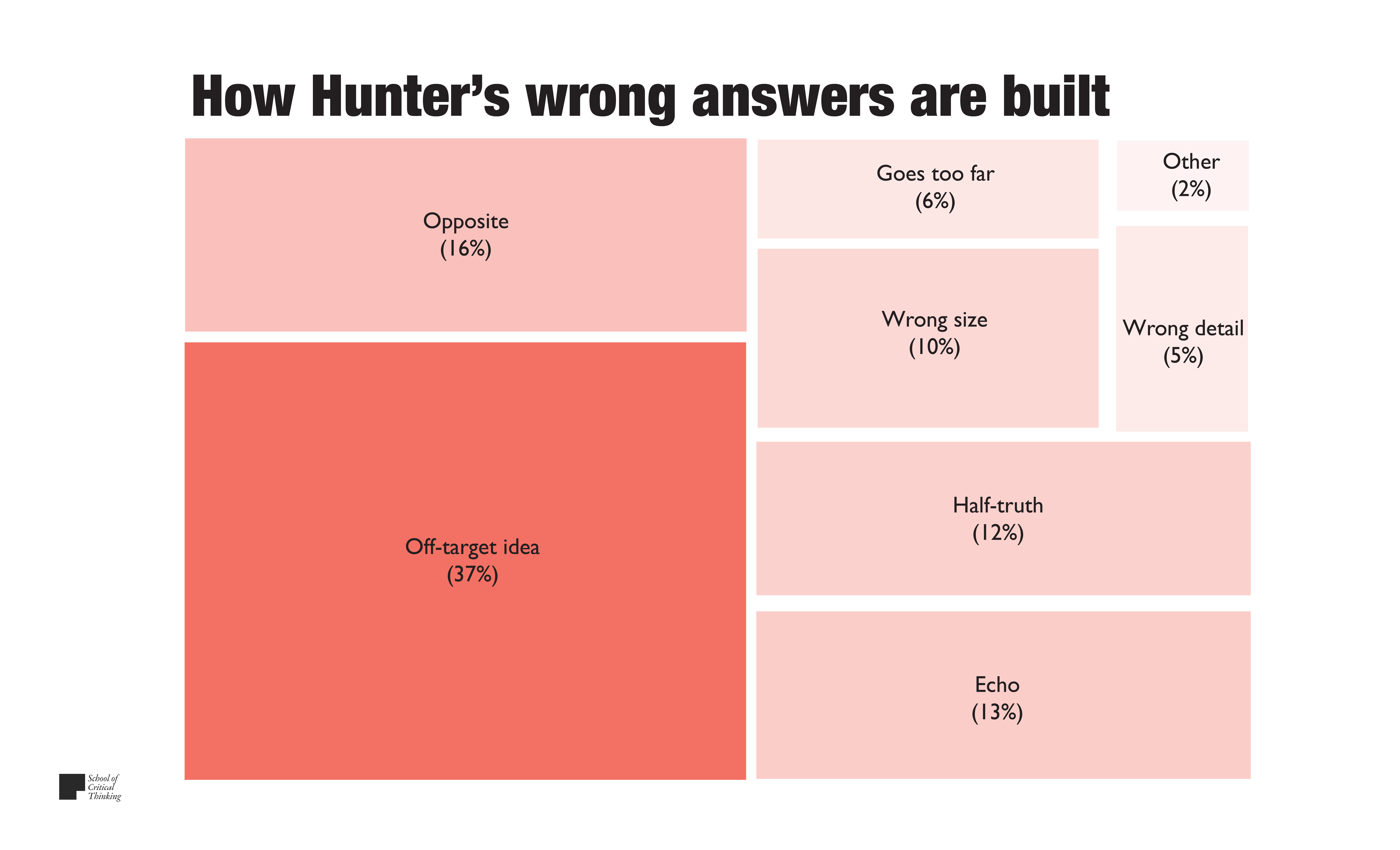
The off-target idea is by far the most common, more than a third of all wrong answers. It works because it sounds like something a thoughtful reader might conclude. The only defense is checking each choice against what the passage actually says.
The answer that sounds most like the passage is often wrong
A common piece of advice for reading tests is to pick the answer that best matches the text. But, is it true in the case of Hunter test?
Using an NLP model that measures how close two sentences are in meaning (called transformers for my fellow ML nerds), I compared every answer choice with every sentence of its passage, then asked a simple question: is the choice that sounds most like the passage the right answer?
Yes, it is (but only 36% of the time). Blind guessing with five choices gets you 20%, so "sounds like the passage" is only slightly better than guessing. And in almost two out of three questions (64%), at least one wrong answer sounds more like the passage than the correct one.

Even though there’s a lot of noise here, two types of traps stand out. Wrong-size traps (too narrow or too broad), especially the too-narrow ones, lift a real detail from the text and offer it as the answer to a bigger question, so they sound very close to the passage. Opposites do something equally sneaky: they keep the passage's subject and vocabulary and flip the meaning (hopeful becomes doubtful), and on the surface they look like a close match.
The right answer, by contrast, usually restates the passage's idea in new words. That's harder to recognize, which is exactly the point.
Copied words are a warning sign
There's a second, simpler way to measure how close an answer is to the passage: count how many of its words appear in the text. Children do this instinctively; they spot a familiar phrase and feel they've found the answer.
So I measured both: how many words each answer choice borrows from the passage, and how close it is in meaning to the passage.

The correct answers borrow surprisingly little: on average, only about one in five of their words appears in the passage. Instead, they paraphrase.
The traps that borrow the most are the wrong-size and wrong-detail traps, the ones that lift a real piece of the text and attach it to the wrong question. Those are Hunter's copy-and-paste traps.
The rule for your child is simple: if an answer looks copied from the passage, slow down and check whether it actually answers the question. Familiar words are not evidence.
Traps are built around the right answer
The trickiest part about Hunter test traps is that they are carefully crafted to look like the true answer. This is done not only by sharing the passage’s words, but also by being very close in meaning to the true answer, so the test-taker needs to exercise careful and nuanced reading.
I tested this computationally. If wrong answers were random, they would be no closer in meaning to the right answer than to any other statement. To check, I compared each wrong answer with its own question's correct answer, and then with the correct answer from a randomly chosen different question.

The difference is significant. On average, a wrong answer is almost twice as close to its own correct answer as to a random one. Hunter's traps live in the same neighborhood of meaning as the right answer, close enough to tempt; different enough to be wrong.
The closest neighbors are the half-truths and the inferences that go too far. They start from the right idea and then bend it: one detail off, or one step too far. That has a practical consequence. On a hard question, after ruling out the obvious misfits, your child will usually be left with two choices that both sound right. That's the moment to ask: what is the one word or phrase that makes this choice wrong?
Math traps
The math sections have their own traps, and they depend on the question format.
Here are the most frequent ones:
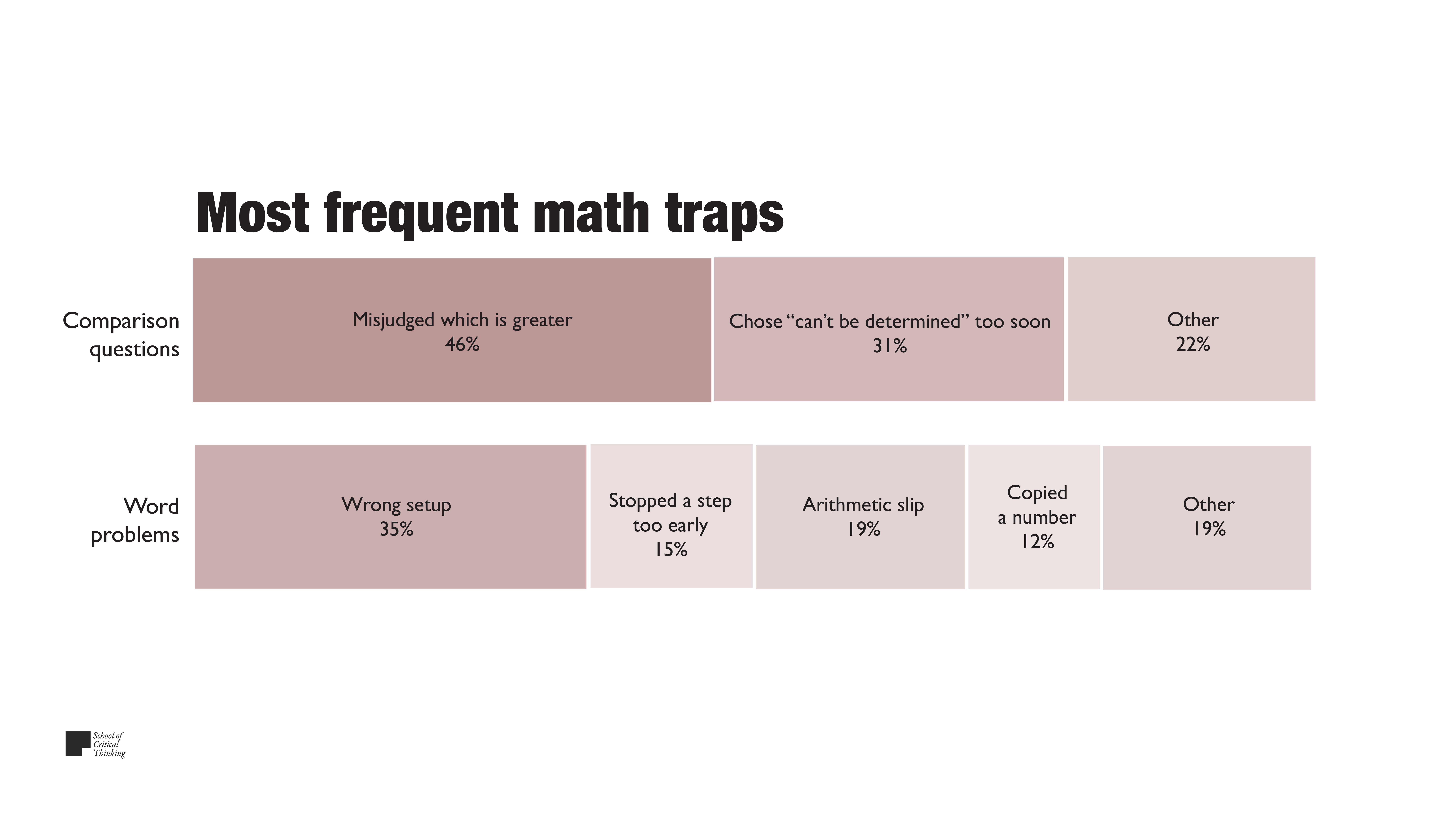
In comparison questions (Column A vs. Column B), two mistakes account for more than three quarters of the wrong answers. The first is simply misjudging which quantity is bigger (duh!). The second is choosing "the relationship can't be determined" when it actually can be. Children reach for that option when a problem feels uncertain, which is understandable, but feeling uncertain and the answer being undetermined are different things. The reverse mistake, missing a case that really can't be determined, is rare.
In word problems, the most common trap is setting the problem up wrong, followed by arithmetic slips, answers that stop one step short of what the question asks, and numbers copied straight from the problem. These are the same families I also found on the SHSAT, which suggests they're common features of how multiple-choice math is written.
How to prepare for the test
The data presented so far also lets us check two pieces of advice students hear all the time:
- "Pick the answer that best matches the passage." As shown above, on Hunter that advice leads children straight into the traps.
- "Avoid answers with extreme words like always, never or only." I counted these words in the full-sentence answer choices. Correct answers use them about as often as the inferences that go too far. On Hunter, extreme words are not a reliable signal either way.
One pattern does exist: the longest answer choice is correct somewhat more often than chance (29% vs. 20%). It's a real tendency but a weak one, worth using only as a last resort when a child truly can't decide.
Other things point out to several concrete (and practical) things you should do with your child, or student. Here are the main takeaways:
- Distrust the echo. If an answer choice sounds just like the passage or borrows its exact words, slow down. On Hunter, the right answer usually says the idea in new words.
- Don't hunt for the sentence that says it. Most answers aren't written in the passage. Before looking at the choices, have your child put the answer in their own words: what does this part of the passage show?
- Name the trap. When reviewing a mistake, ask which kind of wrong answer caught them: off-target idea, opposite, echo, half-truth, wrong size, overreach or wrong detail. Naming it is how a child learns to see it next time.
- Find the word that makes it wrong. On hard questions, the last two choices are usually the right answer and a close copy of it. Have your child find the specific word or phrase that makes one of them false.
- Use the swap test on vocabulary. Put each choice into the sentence in place of the word and keep the one that preserves the meaning. Watch for familiar words used in a less familiar sense.
- In comparison questions, test before choosing "can't be determined." Try two or three concrete numbers. Only if the answer changes is it truly undetermined.
- Forget the extreme-words rule. On Hunter, it doesn't separate right answers from wrong ones.
What do do next?
Over the last four articles, the Hunter exam has come into focus as a test of one central skill: reading what isn’t said. Inference is the largest share of the reading questions, and most inference questions don’t announce themselves. The passages carry their difficulty in long, layered sentences rather than hard words. And the wrong answers are built to reward children who match words instead of meaning.
That’s good news for families, because this skill can be trained. But training only works when you know what to train, and that’s where most prep goes wrong. Two children can miss the same number of questions for completely different reasons. One keeps falling for echoes; another reads well but gives up too early and picks “can’t be determined” or runs out of time on long, layered passages. Children almost never notice which of these is happening to them; they just know they got the question wrong. More practice tests won’t fix that. They tend to repeat the same mistakes, only faster.
So the most useful thing you can do right now is find out which traps catch your child, while there’s still time to change the habits behind them. With the next test expected in January, a few weeks of targeted practice on the right trap is worth more than months of general drilling.
That’s exactly what our Hunter Baseline test is built to show. It follows the structure of the real exam, every wrong answer on it is built around one of the trap types in this article, and the report tells you which traps your child fell for, how often, and which habits to work on first. The best thing about it is: it’s absolutely free, no gimmicks.
Start the free Hunter Baseline test →
Good luck!
Stay sharp
New research and test-prep insights, straight to your inbox.
What next?
Start with a free baseline test. Full exam, full error analysis, no credit card.
SHSAT Prep
Full-length adaptive practice tests reverse-engineered from the official DOE handbooks. Free baseline test with error analysis.
Start SHSAT prep →See the science behind it
How we analyzed over 1,300 questions and five thousand answer choices to figure out what the SHSAT is really made of.
See the method →Free baseline test
100 questions. Full error analysis. No credit card required.
Start the free baseline test →