The hidden logic of Hunter test questions
 Eldar Sarajlic
·

In one of the earlier articles about the NYC’s Hunter High School admissions test, I looked at the reading passages on the exam: what they're made of, and which features show up in the passages with the hardest questions.
This time I want to look at the questions themselves.
As seasoned test-takers know, a question is never neutral. The way it's worded and how its answer choices are built uniquely shape the question’s difficulty. Test makers know this well; that’s why they design questions with a lot of care and precision.
So, as usual, I went through all 97 reading questions in Hunter's two official sample tests, plus the two sections of math questions, and looked at how they're built: how they're phrased, what in the passage they point to, what their answer choices look like, and how each of these relates to difficulty.
The results I’ll present here show us a set of patterns that might fly under our radar, yet each of them could easily translate into a concrete habit for your child’s (or student’s) practice. I’ll start with the ELA section (because it is usually harder; math is much more straightforward).
Questions as incomplete sentences
The first pattern is visible on every page of the test, yet easy to overlook: not one of the 97 reading questions ends with a question mark. That may sound weird, until you look closely: each question is an unfinished sentence, and the answer choices complete it. They look like this, for example:
Sylvia will not tell the hunter where the heron's nest is because…
This changes the answering task in a subtle way. The job is not to pick an answer to a question so much as to choose which of five endings makes a true (logical and meaningful) sentence. The best way to work through these is literally to read each ending onto the sentence (out loud or in your head) and ask: is this whole sentence true, according to the passage?
The second pattern is even more surprising. On the SHSAT, for example (another test your child might take in a few years from now), a handful of standard phrasings (like "Which sentence best states the central idea?") cover most of the test, so a well-prepared student recognizes question types instantly.
Hunter works differently. Apart from one fixed format for vocabulary ("As used in line 12, ascertain means…"), almost every question is written specifically for its passage.
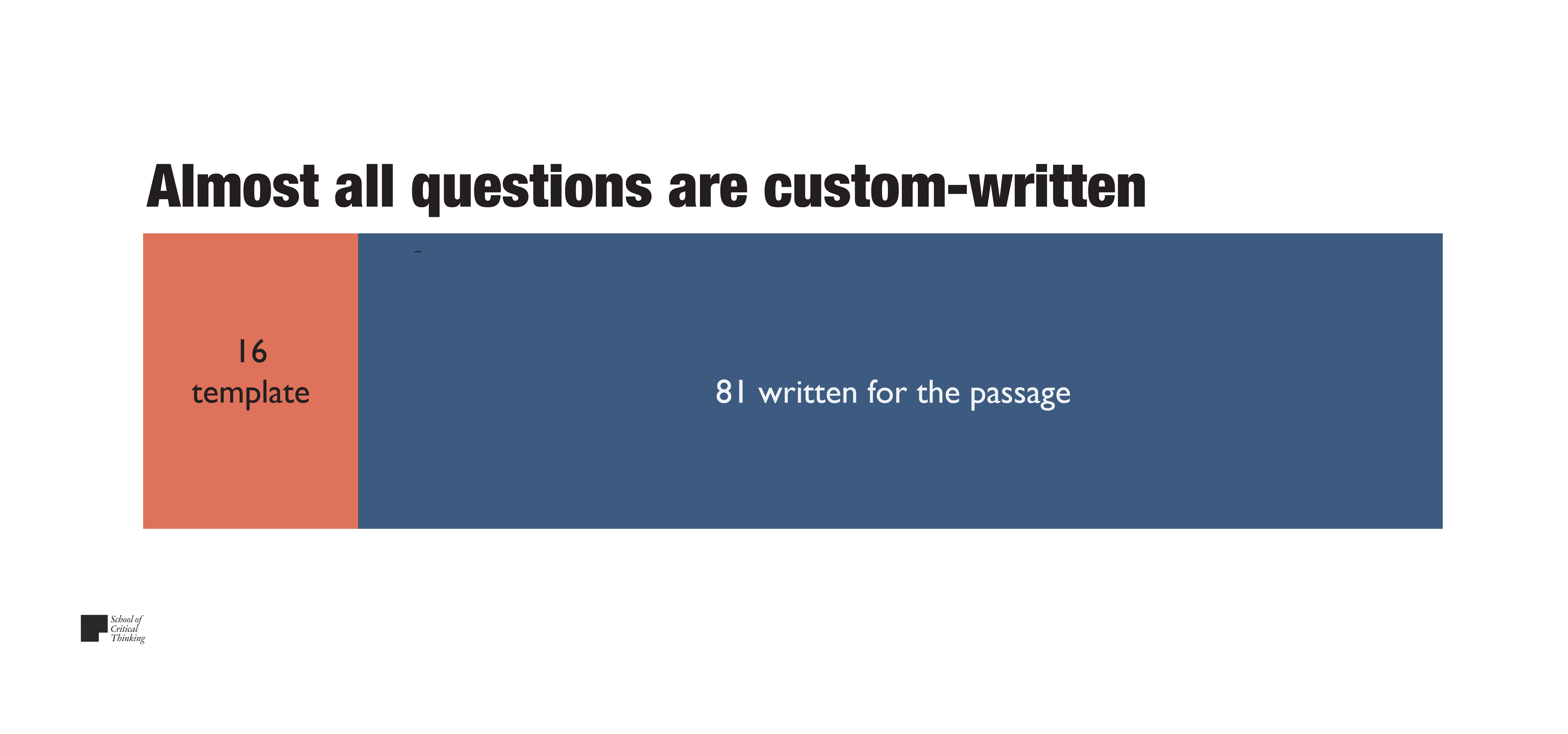
The 81 custom questions have 74 different openings, nearly one per question. So there's no menu of question types to memorize for Hunter. Your child has to read every question as carefully as the passage itself.
The order of questions
About half of Hunter's reading questions point to specific lines: "in line 9, the author says…" or "lines 14–17 suggest that…" and similar. When I followed those line numbers question by question, I noticed a clean pattern. Within every passage, the questions move forward through the text; they never look back. Across all nine passages with line references, the next question's line came after the previous one every single time (39 out of 39).
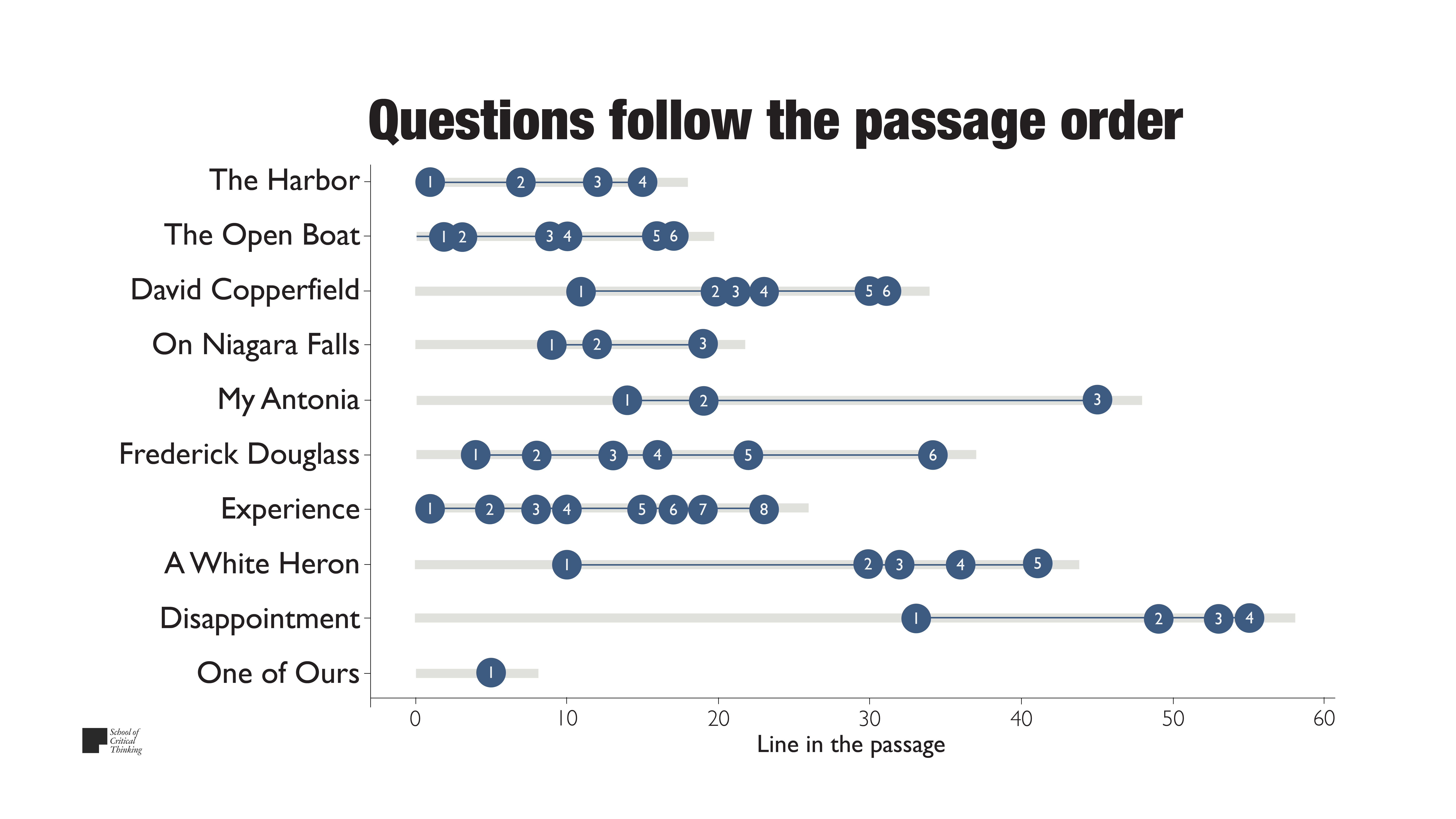
I think this is one of the most useful things a child can know going into the test. It means there's no need to read an 800-word passage in full and then hunt backward for each answer. Your child could read the first part, answer the questions about it, then read on, staying close to the text the questions are about.
One caution: questions about the passage as a whole (its overall tone, the narrator's final attitude) don't point to lines, so they don't follow this pattern. Those are best answered after finishing the entire passage.
The scope of questions
Another interesting finding is how much the difficulty of a question relates to its scope. For example, Hunter questions look at the passage from different distances. Some zoom in on a single word, some on a line or two, some on a stanza or paragraph, some on a character or a moment in the story, and some on the passage as a whole.
So, it's natural to assume that the closer a question zooms in, the easier it gets: a question about two lines should be simpler than a question about the entire passage.
However, the data says otherwise.
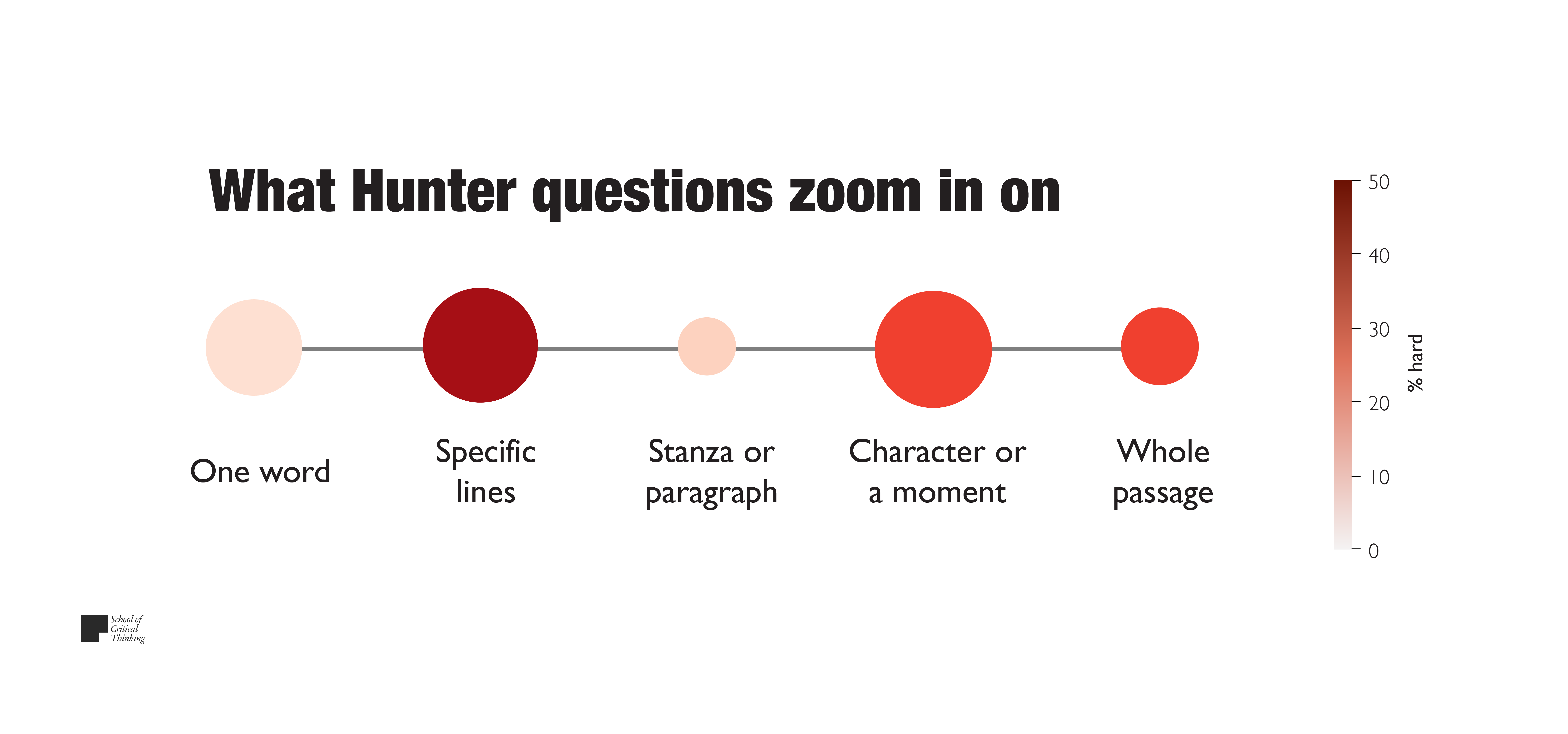
As you can see in the chart, single-word questions are indeed easy: only about 1 in 16 is rated hard. But only about a third of the questions about specific lines are hard. The reason is what those line questions ask: most of them want to know what a line suggests rather than what it says, such as what a description reveals about a character or what an image implies about the narrator's mood.
So a small piece of text can carry a big question. When a question sends the test-taker to two lines in the passage, those two lines deserve a slow, careful reread, not a quick glance.
What length in answer choices reveals
Hunter's answer choices come in three basic shapes. Some are single words (like “comforting,” “indifferent,” “scornful”); some will include short phrases (such as “between two worlds”); and some will be full statements (like “one's view of a situation depends on where one is”).
The shape turns out to be one of the clearest signals of difficulty on the whole test:
- Single-word choices: 8% of these questions are hard.
- Short phrases: 34%.
- Full statements: 39%.
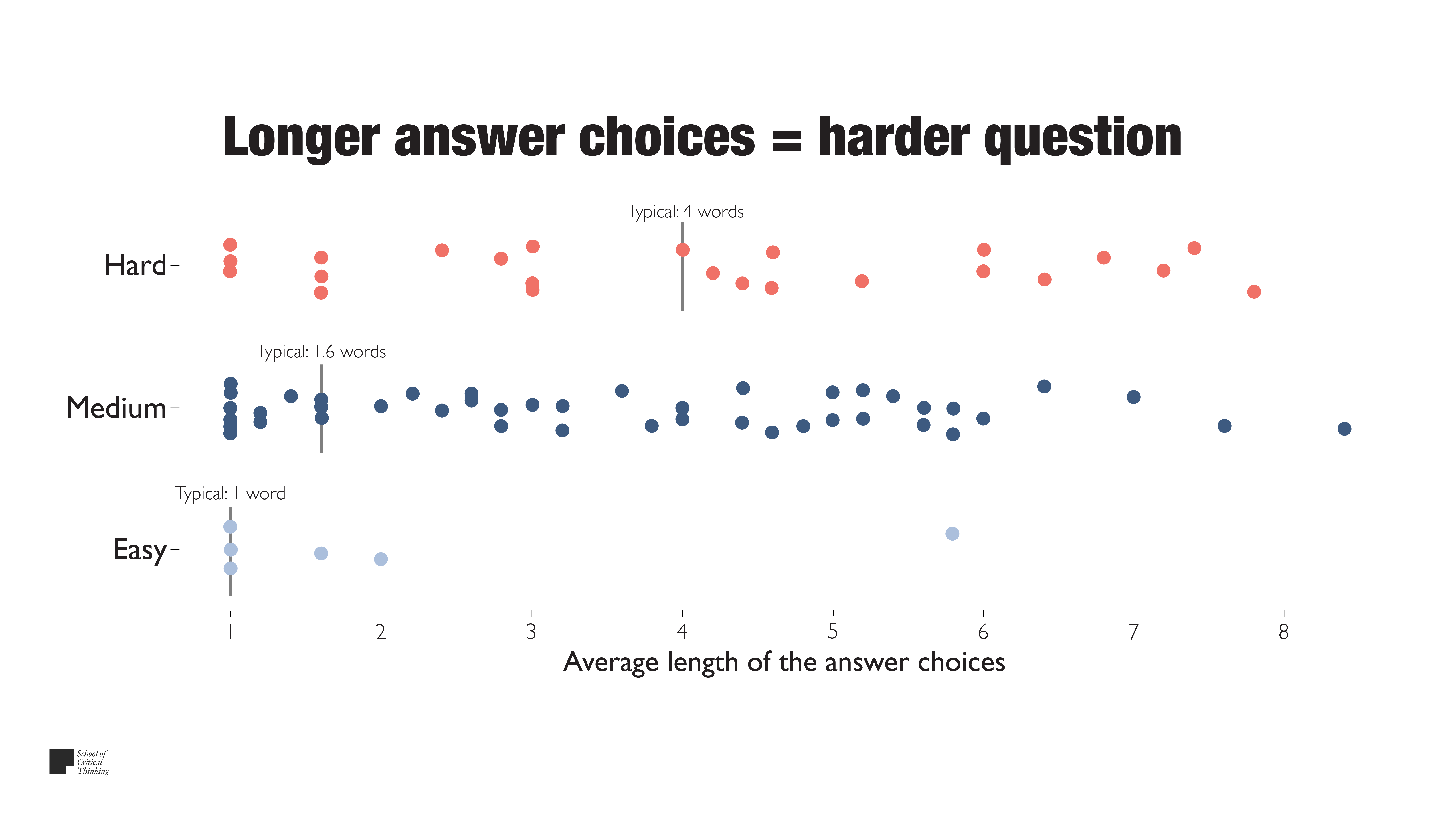
This isn't only about vocabulary questions. Many single-word questions ask for a character's trait or a narrator's tone, and those are mostly easy too. The difficulty rises when every choice is a claim of its own, because then each one has to be checked against the passage separately, and the wrong ones are often partly true.
For your child, this translates into a simple time-management rule: move quickly through single-word questions, and spend the saved time on the questions with long answer choices.
Inference in disguise
Inference is the backbone of Hunter reading: 40 of the 97 questions ask the child to answer a question about something the passage never says explicitly.
You might expect those questions to announce themselves with words like suggests or implies. Most of them don't use any word that would signal inference is required.
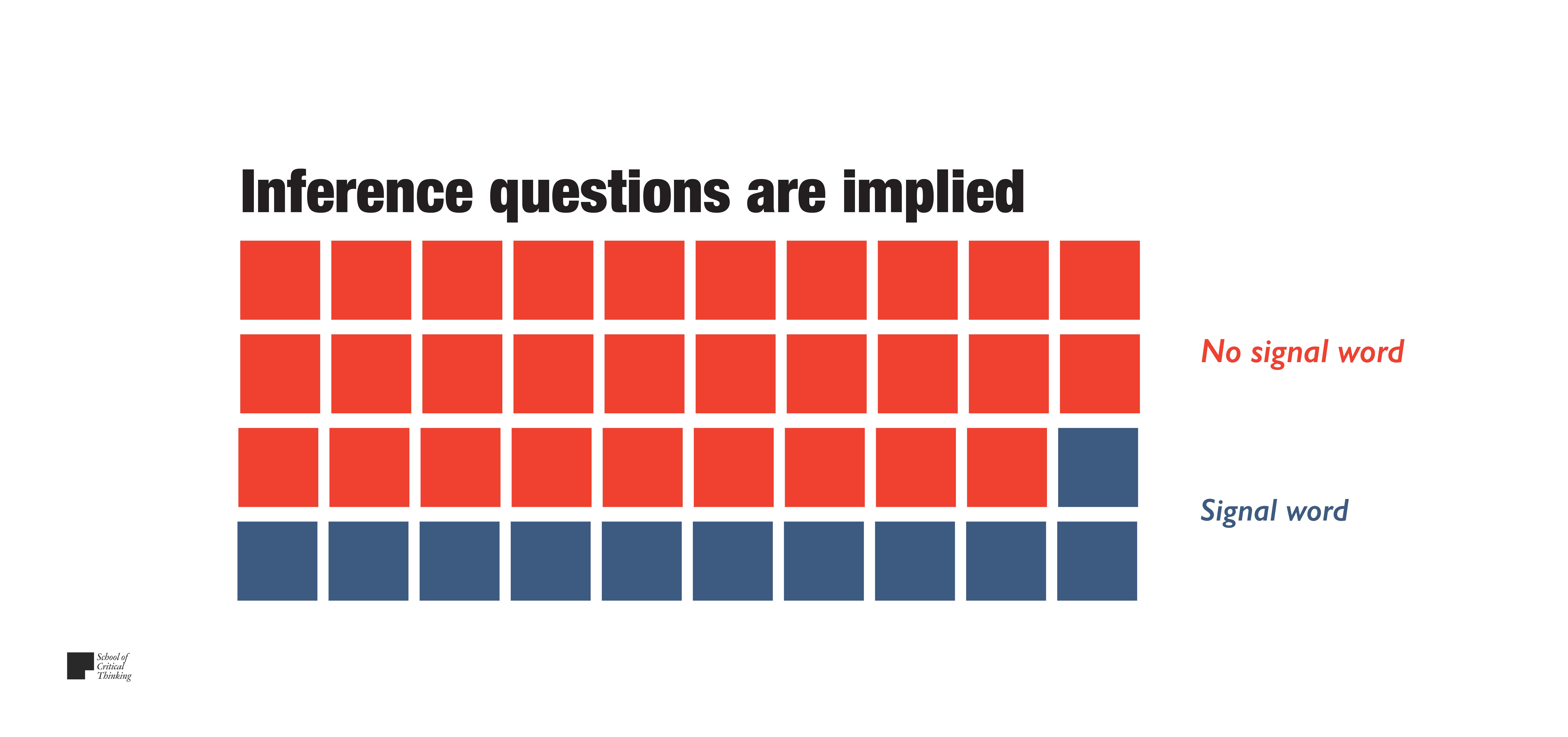
Of the 40 inference questions, 29 (72%) give no signal at all. They read like plain questions about the story. For example:
“The narrator decides not to tell his mother his plans to run away because she would…”
“Compared to Ántonia's life, the narrator's life is…”
Nothing in the wording tells the child that the answer isn't written anywhere in the passage. Many of these end in "because" and ask why a character does something, a motive the author leaves unsaid.
A child who treats them as "find the sentence that says it" will search for an answer that doesn't exist. As a result, they will lose precious time on the test, and will often settle for a choice that echoes the passage's words without answering the question. So, pay attention to these inferences in disguise.
Using AI to prep for inference?
Given the wide availability of AI tools, I’m sure many parents resort to ChatGPT (or any other app) to make questions for their child to practice.
I was curious to what extent would doing this be reliable. So I asked a widely used AI classification model to sort the same questions into types (without seeing my labels) so I could see if it could recognize different kinds of questions (especially the tricky inference ones).
On straightforward categories it did well: it identified every vocabulary question correctly. But on inference it struggled badly, recognizing only 6 of the 40, and spreading the rest across "detail," "tone" and "vocabulary." It misread several even when the word suggests was right there in the question.
Check out the chart below (left side is human classification, right side is AI; blue is correct, red is incorrect).

If an AI model trained on millions of sentences can't reliably tell an inference question from a detail question, we shouldn't expect an eleven-year-old under time pressure to do it by instinct. It has to be practiced as a deliberate habit.
Math: new format for middle-schoolers
The same attention to question format pays off in the two math sections.
Nearly half of Hunter's Quantitative Reasoning section (18 of 40 sample questions) uses a format most sixth graders have never encountered: quantitative comparison. Instead of solving for an answer, the child sees two quantities, Column A and Column B, and chooses one of four fixed options:
- A: Column A is greater
- B: Column B is greater
- C: the two are equal
- D: the relationship can't be determined from the information given
Two things stand out. First, none of the 18 comparison questions in the sample tests is easy. The format itself doesn't necessarily make questions harder (it is fairly straightforward), but it removes the easy ones.
Second, look at how often each answer was correct:

"Can't be determined" was the correct answer only once in 18 questions. Note that this finding is based on a small sample (and if test-makers see this article, they may correct the imbalance). But it matches what I found in the wrong answers: choosing D when the relationship can be worked out is one of the most common mistakes in this format. Children reach for it when the problem feels uncertain, which isn't the same as the problem being undetermined.
The habit to teach: before choosing D, try two or three concrete numbers. If Column A wins every time, the answer is A. Only if the winner changes depending on the numbers is the answer D.
How to prepare for the test
What I gave you here is intelligence: data-based insight into the workings of the Hunter test, based on the samples publicly provided. What do you choose to do with this depends on you. Success on the test is a reflection of not just insight, but preparation. So, practice, practice, practice.
Still, if you want some concrete takeaways, consider these and teach them to your child (or student):
- Finish the sentence. For every question, read each answer choice onto the end of the question and ask whether the complete sentence is true according to the passage. Practice it out loud at first.
- Read in chunks and answer as you go. Line-specific questions follow the passage in order. Read a section, answer the questions about it, then continue. Save whole-passage questions for the end.
- Ask "stated or figured out?" before answering. Most inference questions don't announce themselves. Before looking at the choices, your child/student should decide whether the answer is written in the passage or has to be worked out. If it has to be worked out, the right answer often won't repeat the passage's words.
- Reread small pieces slowly. When a question points to two lines, those lines usually carry a big idea. Reread them carefully, and ask what they reveal rather than what they say.
- Spend time where it matters. Move quickly through single-word answer choices and give the extra time to questions with long, statement-style choices, where each option has to be checked separately.
- Practice the comparison format, and test before choosing D. A few short practice sets make the format familiar. In every comparison question, try concrete numbers before deciding the answer can't be determined.
- Don't rely on recognizing question types. Unlike the SHSAT, Hunter writes almost every question from scratch. Careful reading of the question itself is part of the skill being tested.
Where to go from here
These habits are easy to describe but hard to build on your own, because a student rarely notices which kind of question tripped them up.
That's exactly what our free Hunter Baseline Test is designed to show. After each test, you will see your child's accuracy by skill and by question type, and the specific kinds of wrong answers that caught them, so you know which of these habits needs work. You can start with the free Hunter Baseline test here.
In the next article, I'll look at the wrong answers themselves: how Hunter's traps are built, and why the answer that sounds most like the passage is often the wrong one. Make sure you don’t miss it.
Good luck!
Stay sharp
New research and test-prep insights, straight to your inbox.
What next?
Start with a free baseline test. Full exam, full error analysis, no credit card.
SHSAT Prep
Full-length adaptive practice tests reverse-engineered from the official DOE handbooks. Free baseline test with error analysis.
Start SHSAT prep →See the science behind it
How we analyzed over 1,300 questions and five thousand answer choices to figure out what the SHSAT is really made of.
See the method →Free baseline test
100 questions. Full error analysis. No credit card required.
Start the free baseline test →