The anatomy of a Hunter test reading passage
 Eldar Sarajlic
·
Reading comprehension questions on standardized test are notoriously hard. One of the main reasons for that is the choice of the passages questions are drawn from: some of them can be extremely complicated, especially for middle school kids.
The Hunter High School admissions test is no exception. One could even say that reading is where the entire test is decided. In my previous article, I showed that the reading section holds about 37% of the multiple-choice questions but roughly 70% of the hard ones.
So if you want to understand what your child is up against, the reading passages are the place to start.
However, most advice about Hunter reading is rather vague: "read more," "build vocabulary," "practice comprehension," etc.
But, I wanted to know what these texts are actually made of. So I took all eleven passages from Hunter's two official sample tests and measured using tools from computational linguistics: length, sentence structure, vocabulary, readability, style. I computed about twenty measures for every passage, so I could identify the underlying patterns.
Some of the findings were really surprising, and they should change how most families prepare for the test. Here's what a Hunter passage looks like from the inside.
What Hunter asks an eleven-year-old to read
The first thing that stands out is the reading list itself.
Nine of the eleven passages in the publicly available sample tests are classics: Charles Dickens, Willa Cather (twice), Stephen Crane, Sarah Orne Jewett, Frederick Douglass, Abraham Lincoln, Carl Sandburg. Only two passages (both poems) are contemporary. Six are fiction, three are poems, and two are nonfiction.
(A fair caveat: public sample tests tend to use older texts because they're free to reprint, no copyright issues are encountered. The real exam may include more modern writing. But the sample is what Hunter chose to show families, so I’d say it's a clear signal of the kind of reading it values.)
The passages vary a lot in length, from a 228-word poem to an 1,128-word excerpt from Cather's One of Ours.
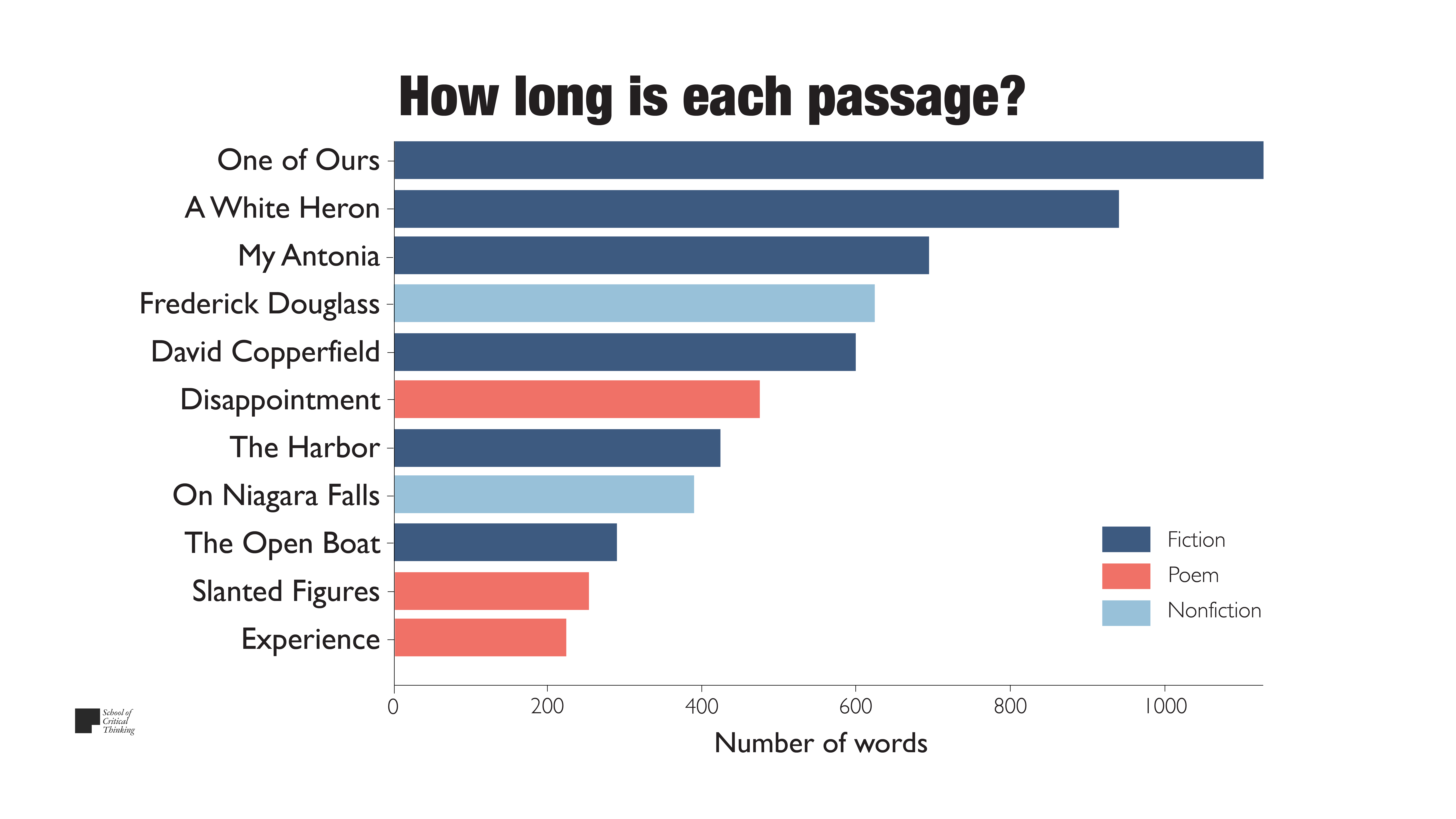
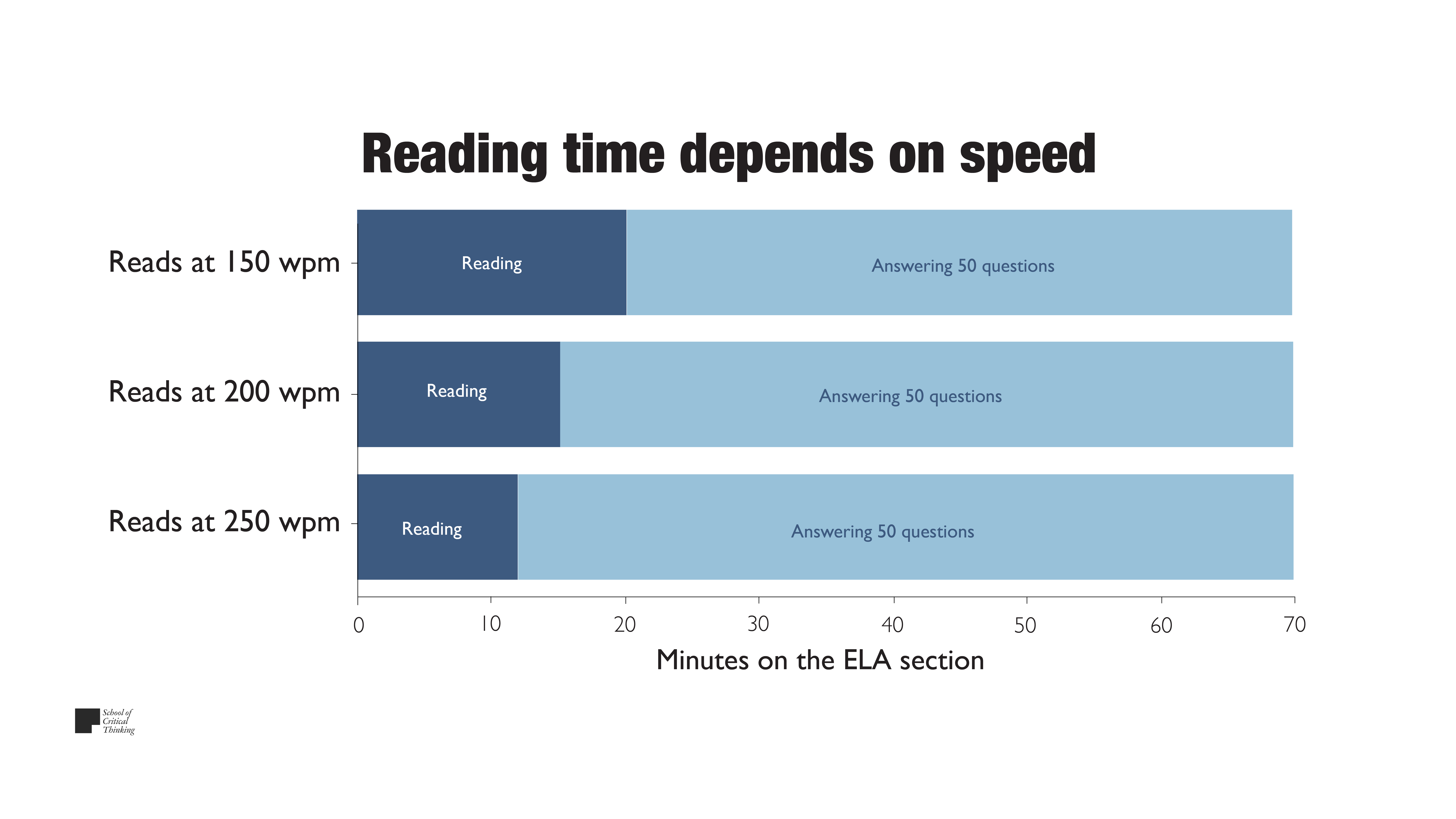
If we add them up, a typical test is likely to have about 3,000 words in passages. Perhaps that doesn't sound like much, until you put it against the clock. The reading section gives your child 70 minutes for 50 questions, so every minute spent reading the passages comes out of that time budget.
This means that their reading speed matters a lot. The faster they can read and comprehend, the more time they will have to answer the ELA section questions.
To measure your child’s reading speed, pick a page from a classic novel they haven’t read before, something like Little Women or My Ántonia.
Ask them to read silently for exactly three minutes, at a pace where they understand what they’re reading, and mark where they stop. Count the words in three full lines of that text, divide by three to get the average words per line, and multiply by the number of lines they read during that time. Divide that total by three, and you have their words per minute (wpm).
Then ask two or three quick questions about what they just read (speed only counts if understanding comes with it). Repeat the test every few weeks with a different book, and you’ll see whether their reading is getting any faster.
Of course, reading the passages is only one part. Students have to read the questions too, and sometimes go back and re-read the passage in light of those questions. If a child is a slow reader, they can easily spend half of the time just on reading and won’t have time to answer all the questions. So, practice reading.
Sentence structure in the passages
If you read one Hunter passage aloud, the first thing you'll notice is the particular shape of the sentences. Many are long, and they're built differently from what children read in most school texts today.
The average sentence across the passages runs about 20 words (the Dickens excerpt averages 32). Five of the eleven passages contain at least one sentence longer than 60 words, so on every test, your child will meet at least one sentence that will be fairly long, which means it has to be held in mind from its first word to its last.
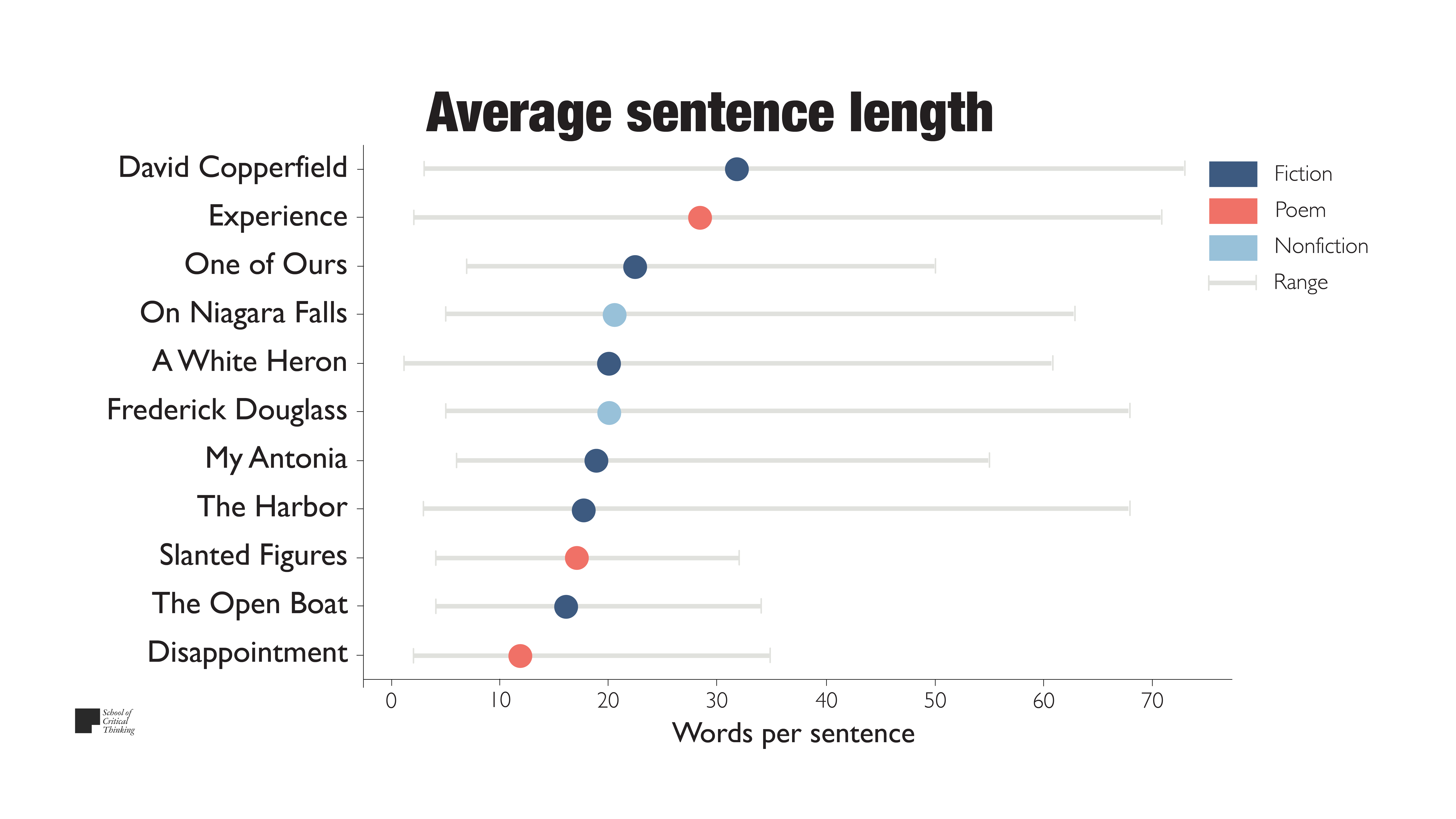
However, averages hide the most interesting part: rhythm of the passage. Some writers keep a steady beat; others swing from a five-word sentence to a sixty-word one and back. Here is the rhythm of the select passages:
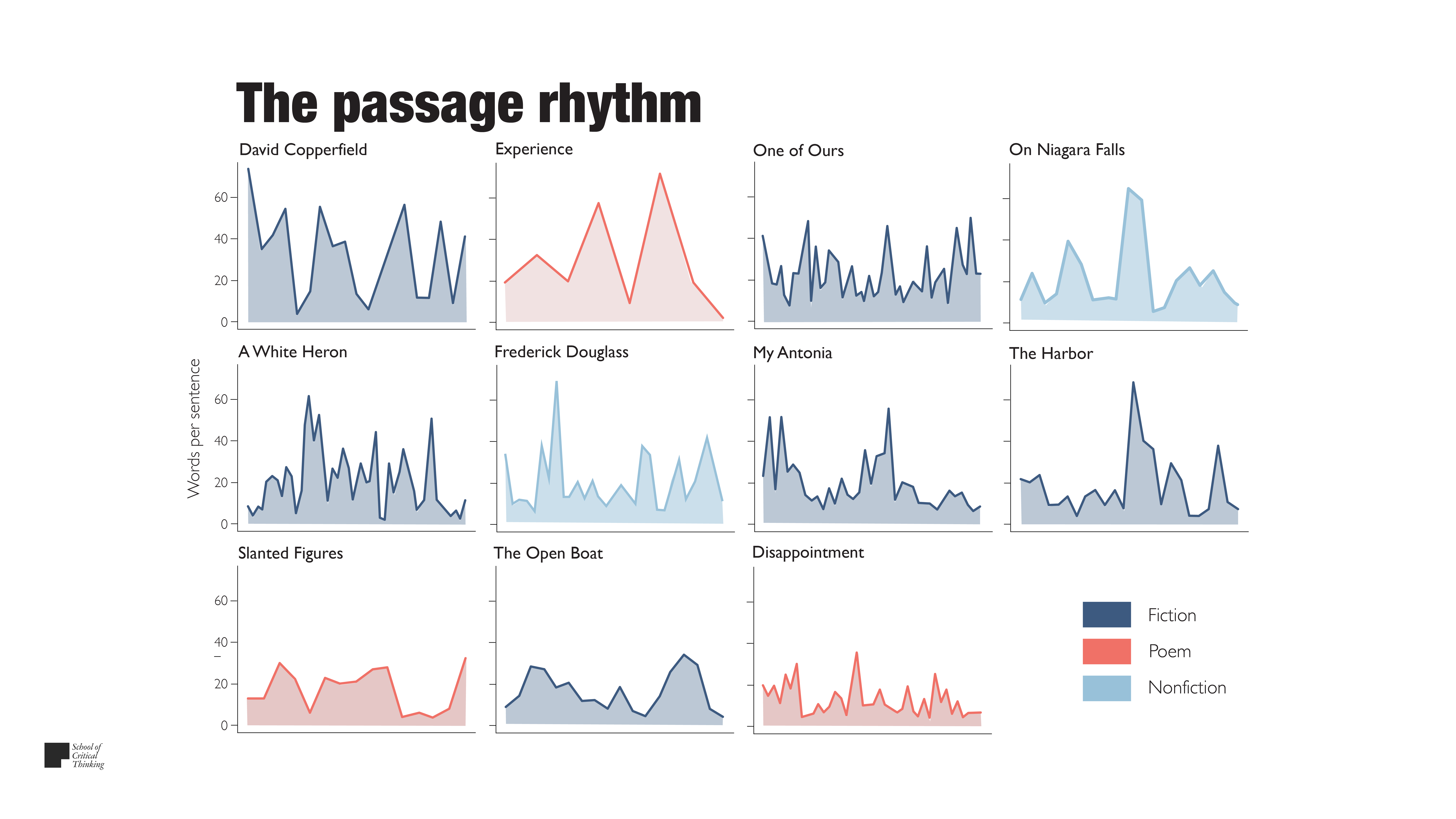
As you can see, Dickens moves in big waves (a drastic exchange of short and long sentences). The modern poem Disappointment keeps a short, even beat. What this means is that a child used to steady, modern prose (the one they get from most children’s or YA fiction) can lose the thread when a passage suddenly shifts gears, (and the classics shift gears constantly). In short: reading classics will help.
Sentence length isn't the whole story either. A long sentence can be a simple list. An actually hard sentence is one that keeps opening new ideas inside old ones: a clause inside a clause inside a clause, with the main point arriving only at the end. Language-analysis software can measure this by diagramming each sentence and counting how many layers deep it goes.
Here’s how deeply nested (and complex) are the sentences in the passages:
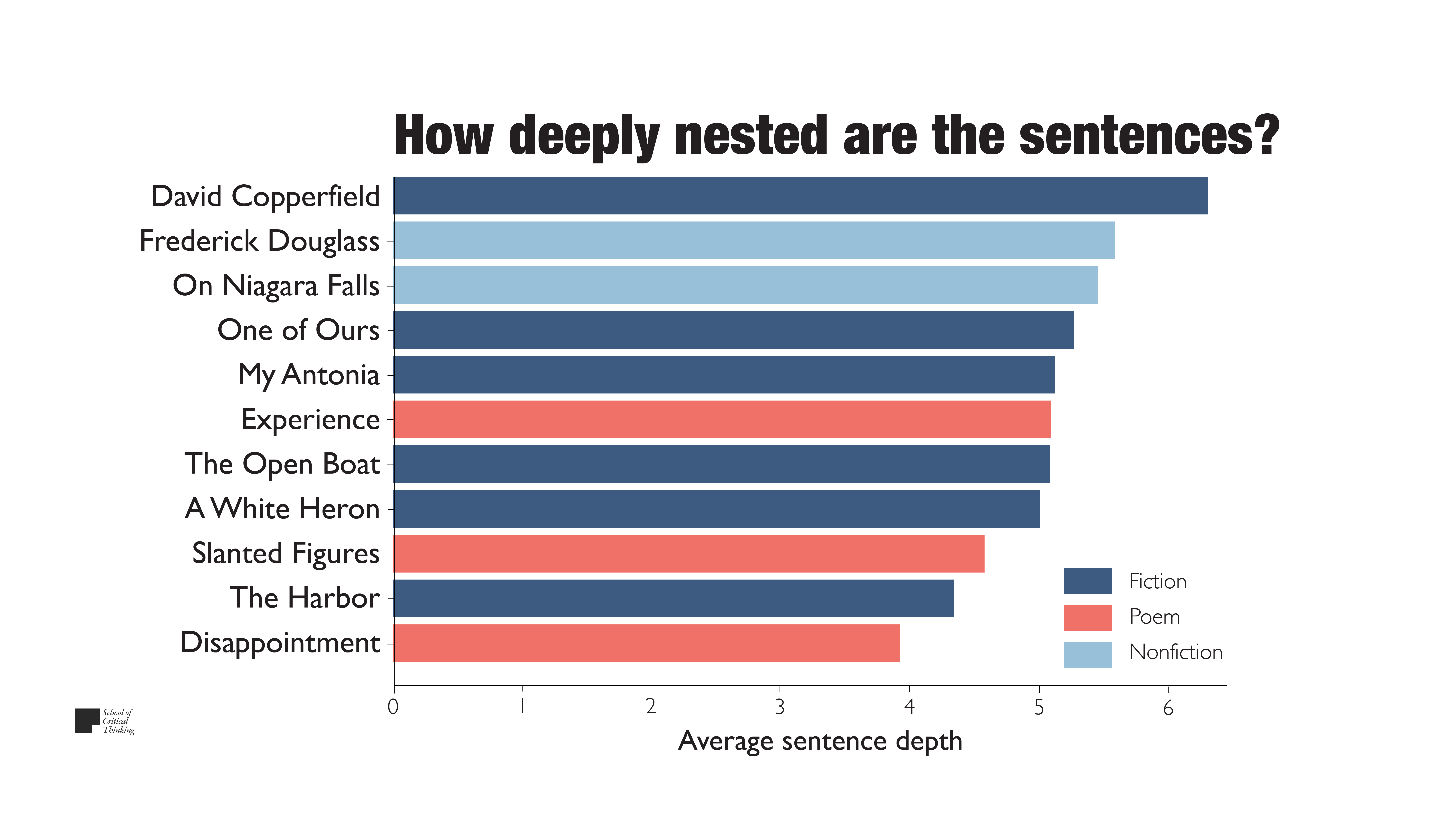
To understand what this means, think of each sentence as a family tree, with the main verb at the top. Every word hangs from another word, and the score counts how many steps it takes to climb from the most deeply buried word back up to the top.
For example, in the sentence “The dog barked,” every word sits one step from the verb, so the score is 1. On the other hand, in “The boy who found the old boat ran home,” the word old describes boat, which is what the boy found, which tells us which boy ran. That’s four steps, so the score is 4. A passage scoring 6.5 means its typical sentence buries some part of its meaning six or seven layers deep.
To follow it, your child has to keep track of six or seven connected ideas before the sentence comes together. The higher the number, the more the reader has to hold in mind at once.
Vocabulary: not what you'd expect
Most people prepping for a standardized test with a reading section consider vocabulary skills (and memory) to be extremely important. Consequently, they put a lot of effort in learning vocab.
I wanted to look more closely at this, so I scored every meaningful word in the Hunter passages (nouns, verbs, adjectives and adverbs) by how common it is in everyday English. My aim was to see how often (and what kinds of) rare words appear on the test, if at all.
(By the way, words that appear less than about once in a million words count as rare).
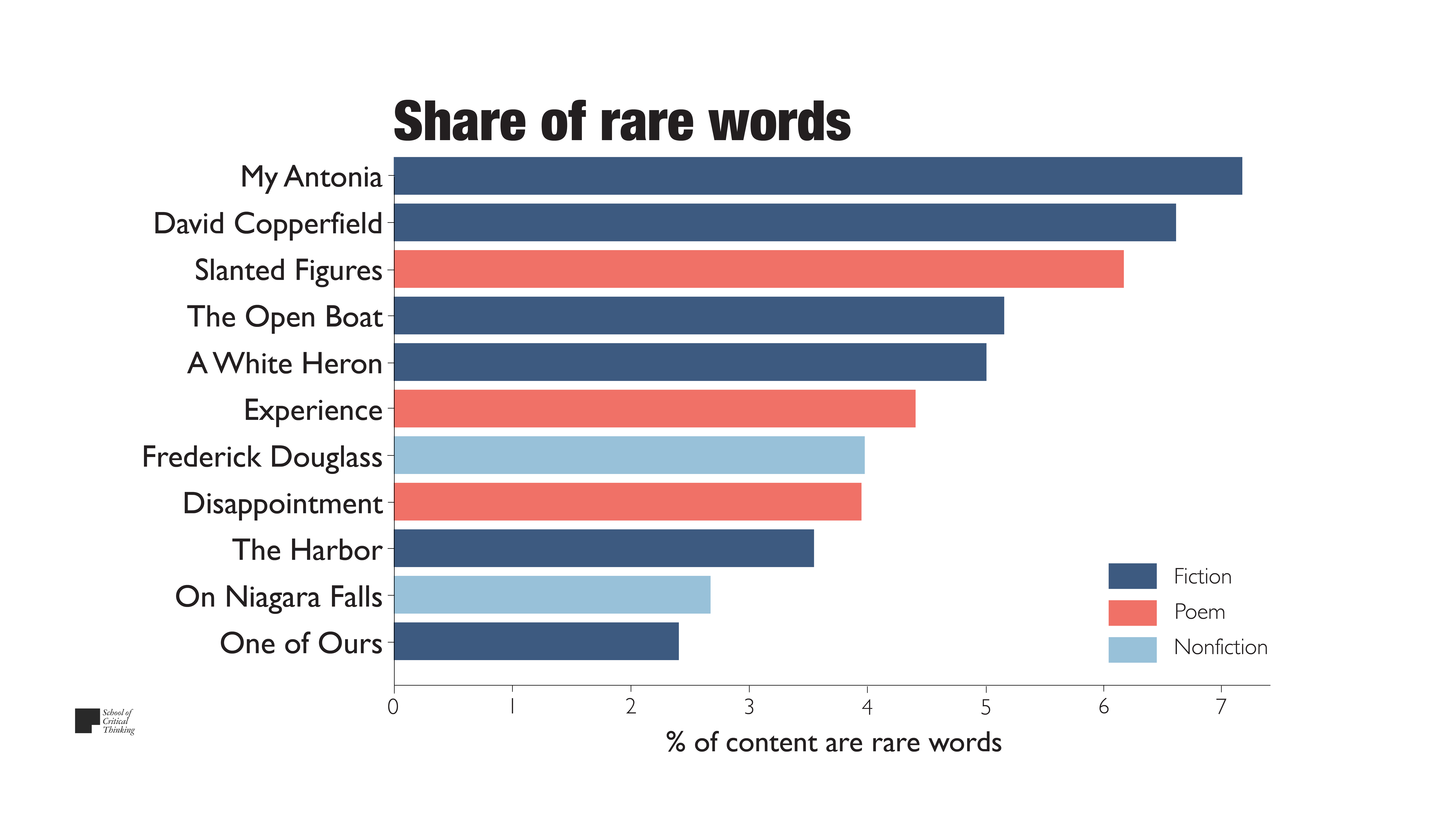
As you can see, rare words make up only about 2–7% of each passage. If you look at which are they, you’ll mostly find words like these: clattered, cobblestone, slush, froth, bough, birches, fowls, farmyard, dewy. These aren't the academic words you find on vocabulary lists. They're concrete, sensory words from the world of 19th- and early-20th-century fiction: farms, weather, animals, old towns.
On the test, an unknown word will sometimes be defined in a footnote, so no need to worry much about it. When it’s not, the only thing that can help is familiarity with classical literature. A child who reads older novels meets them naturally; a vocabulary app almost never teaches them.
The overall familiarity of the vocabulary tells a similar story. On average, the words in these passages are quite common.
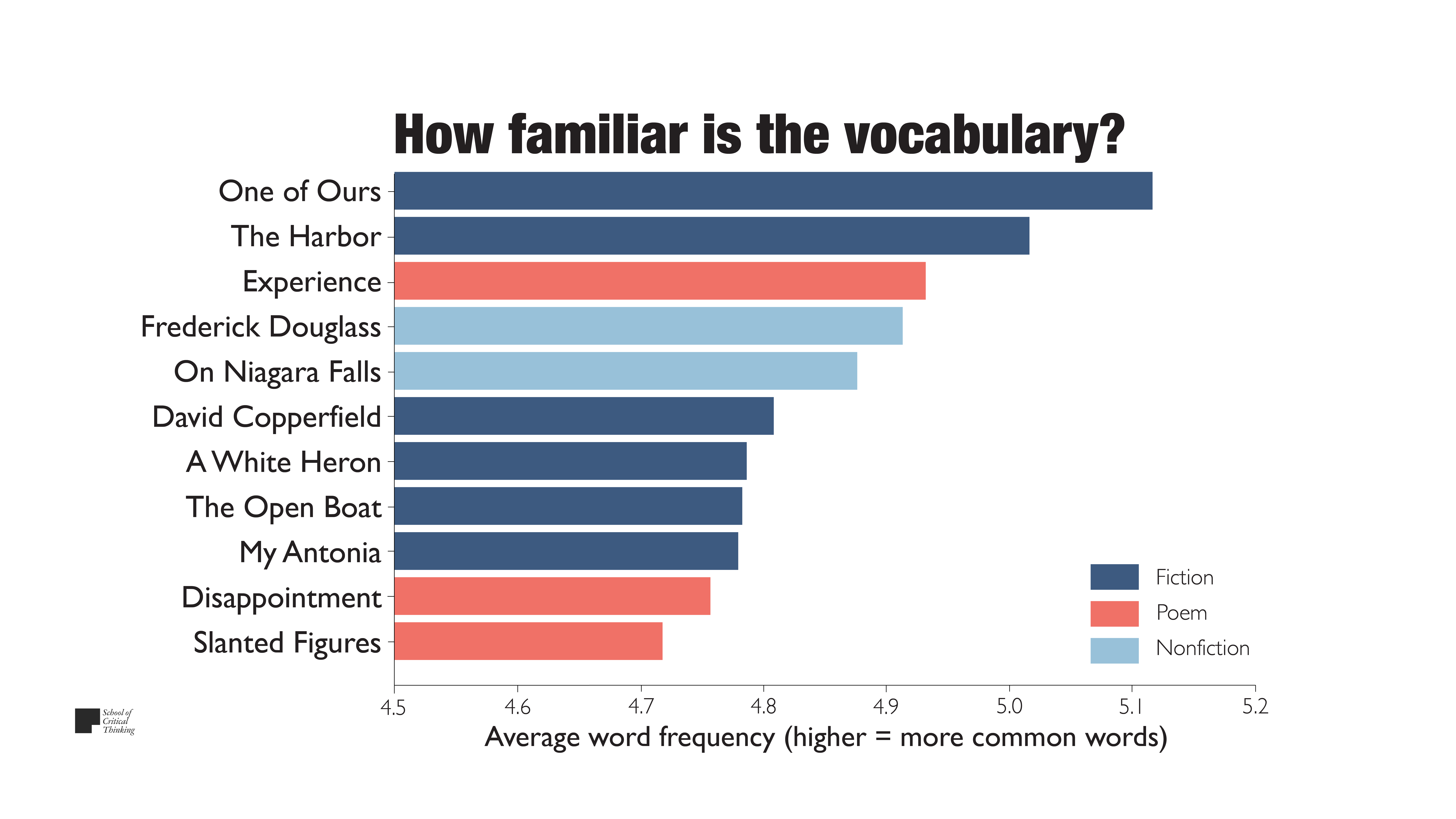
I also measured how varied the vocabulary is: whether a text keeps introducing new words or reuses the same ones. On this measure, the Hunter passages are remarkably alike. Only the modern poem Slanted Figures stands out, with noticeably more variety, as poems often have.
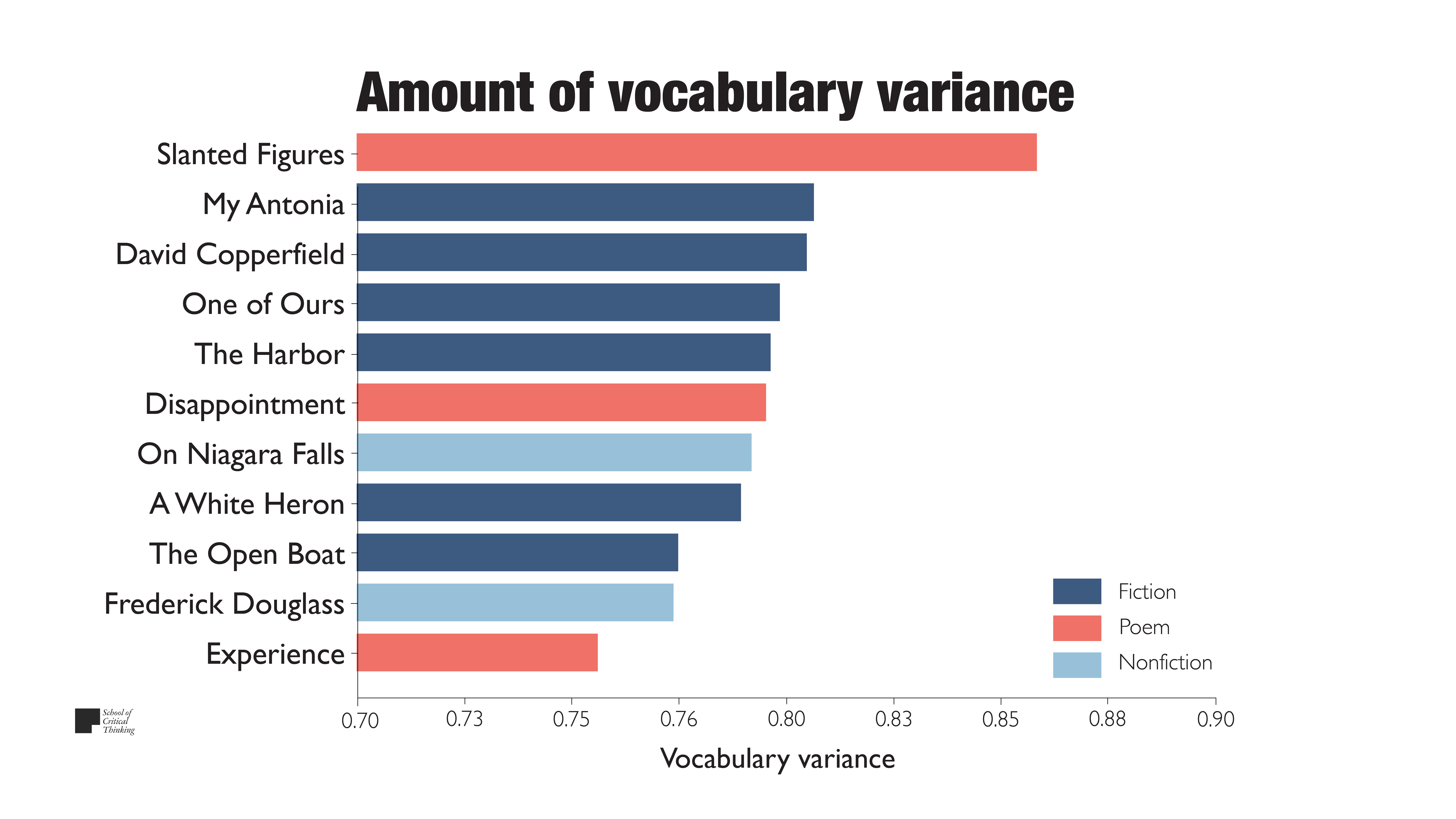
Now compare this finding with the difficulty of the questions.
The passage with the hardest questions, Cather's One of Ours (64% of its questions rated hard), has the most familiar vocabulary of all eleven. And Lincoln's On Niagara Falls, the passage with the longest words, has no hard questions at all.
What does this tell us? On the Hunter test, hard words and hard questions are two different things.
Reading complexity: can 6th graders really understand it this?
When you first read a passage from the Hunter test samples as a parent, what strikes you the most is how mature and high-level some of them are. Yet, your 6th grader is expected to read and reason about them.
How complex are these passages, really? What grade level are there?
The metric used by computational linguists that tells us this is called Flesch-Kincaid grade level. By this formula, the Hunter passages range from about grade 4 to (almost) grade 12:
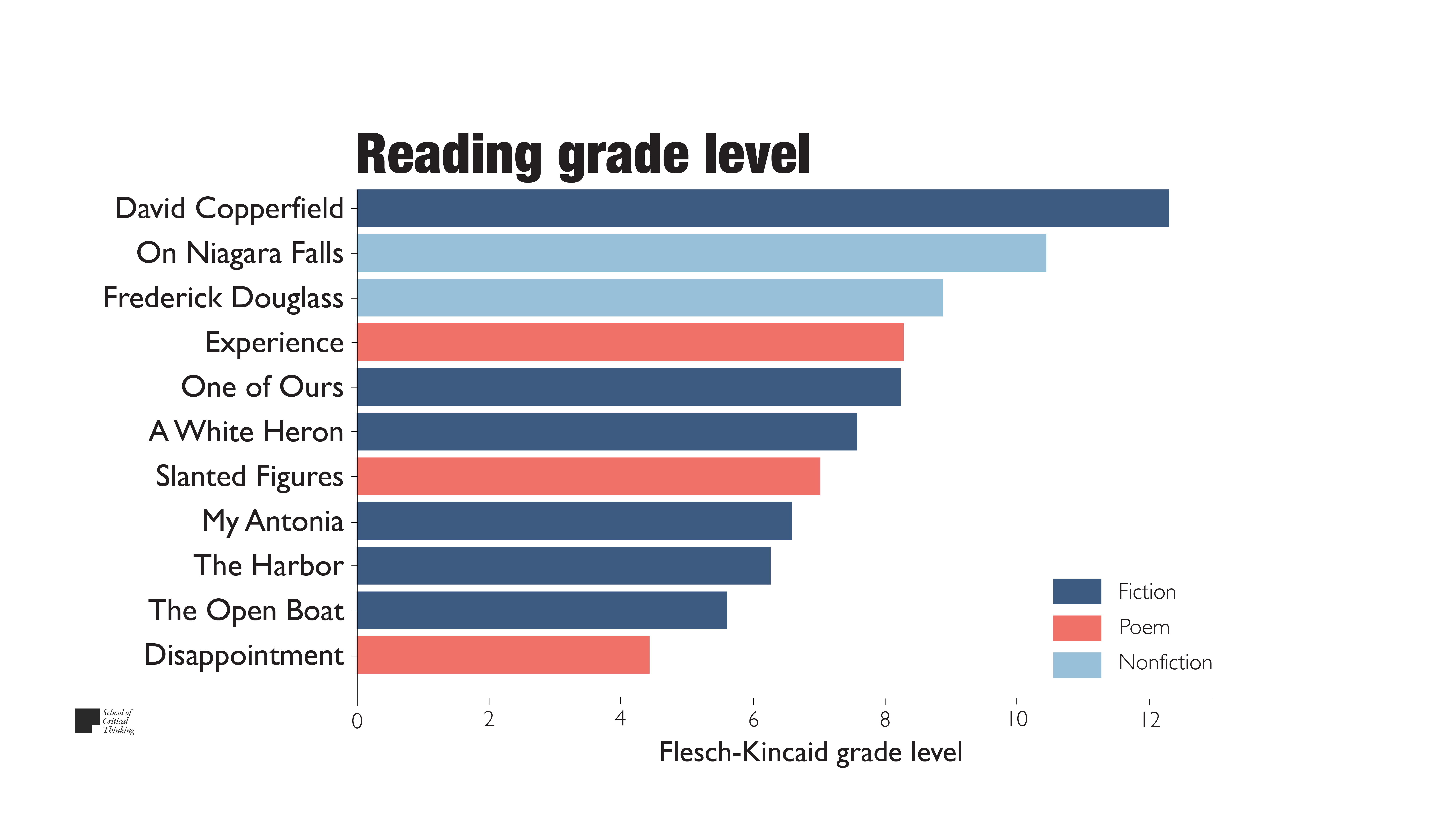
This is the craziest thing I’ve found out in this analysis: yes, your 6th grader hoping to get into Hunter High should already be reading at the high school level.
There are another two things worth knowing about these numbers.
First, they badly underrate classic fiction. Several of the novel excerpts score around grade 5, yet anyone who has read Cather or Jewett knows they aren't fifth-grade texts. Their difficulty lives in what isn't said: unstated feelings, subtle shifts in tone, details that matter only later. Simple counts can't see any of that.
Second, grade level is a weak guide to how hard the questions will be.
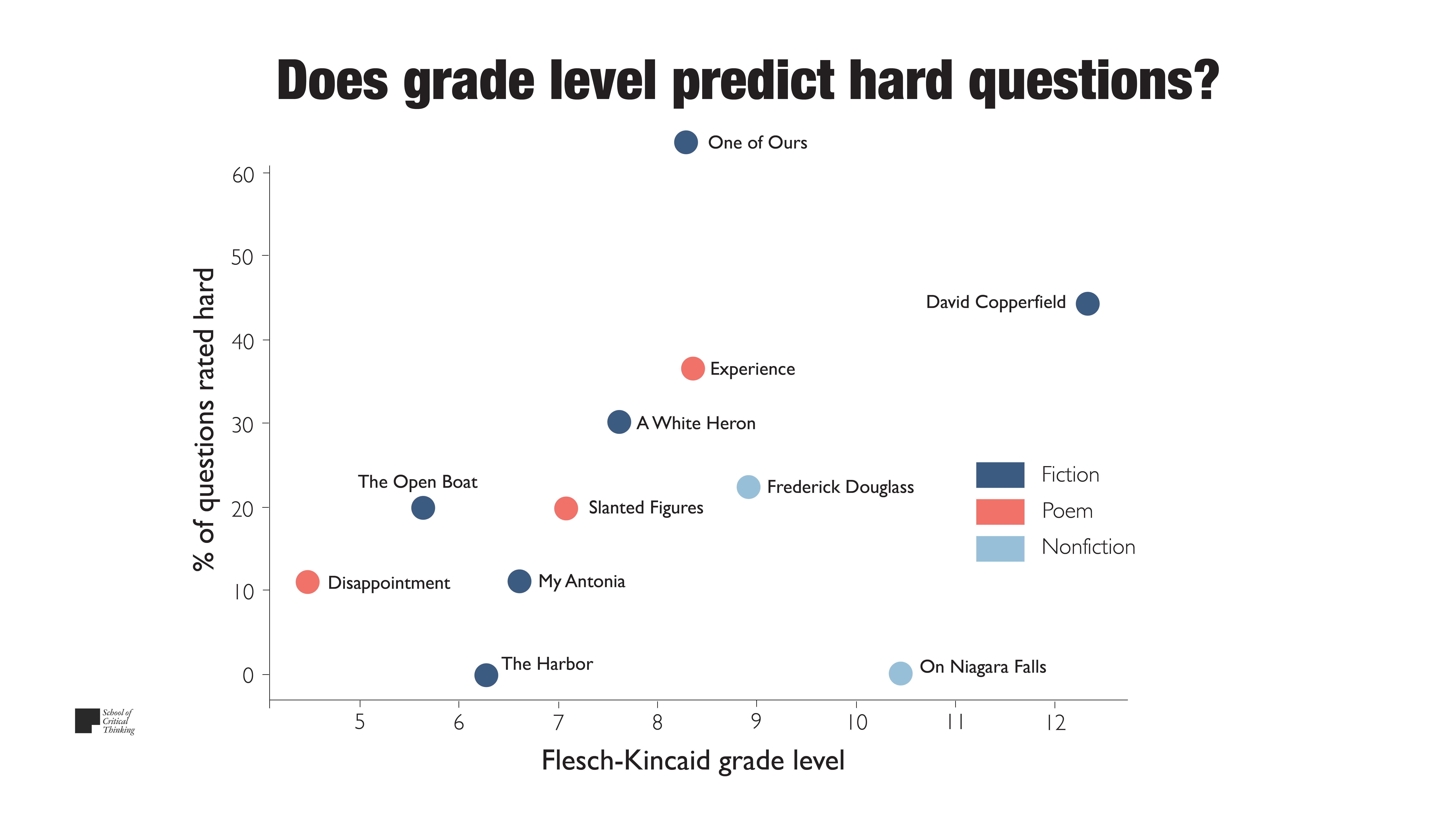
There's a distinguishable correlation (for my fellow stats nerds, r = 0.45), but there is a lot of variance, and with only eleven passages, the pattern isn't strong enough to rely on. This means that choosing practice texts by grade level alone will miss what actually makes Hunter reading hard.
So what makes a Hunter passage hard?
To answer this question, I put every measure side by side for every passage. In the chart below, each row is a passage and each column a measure. Red means above average, blue means below average. The rows are sorted by the share of hard questions, with the hardest passages at the top (only the last column to the right is sorted by color, as you can see).
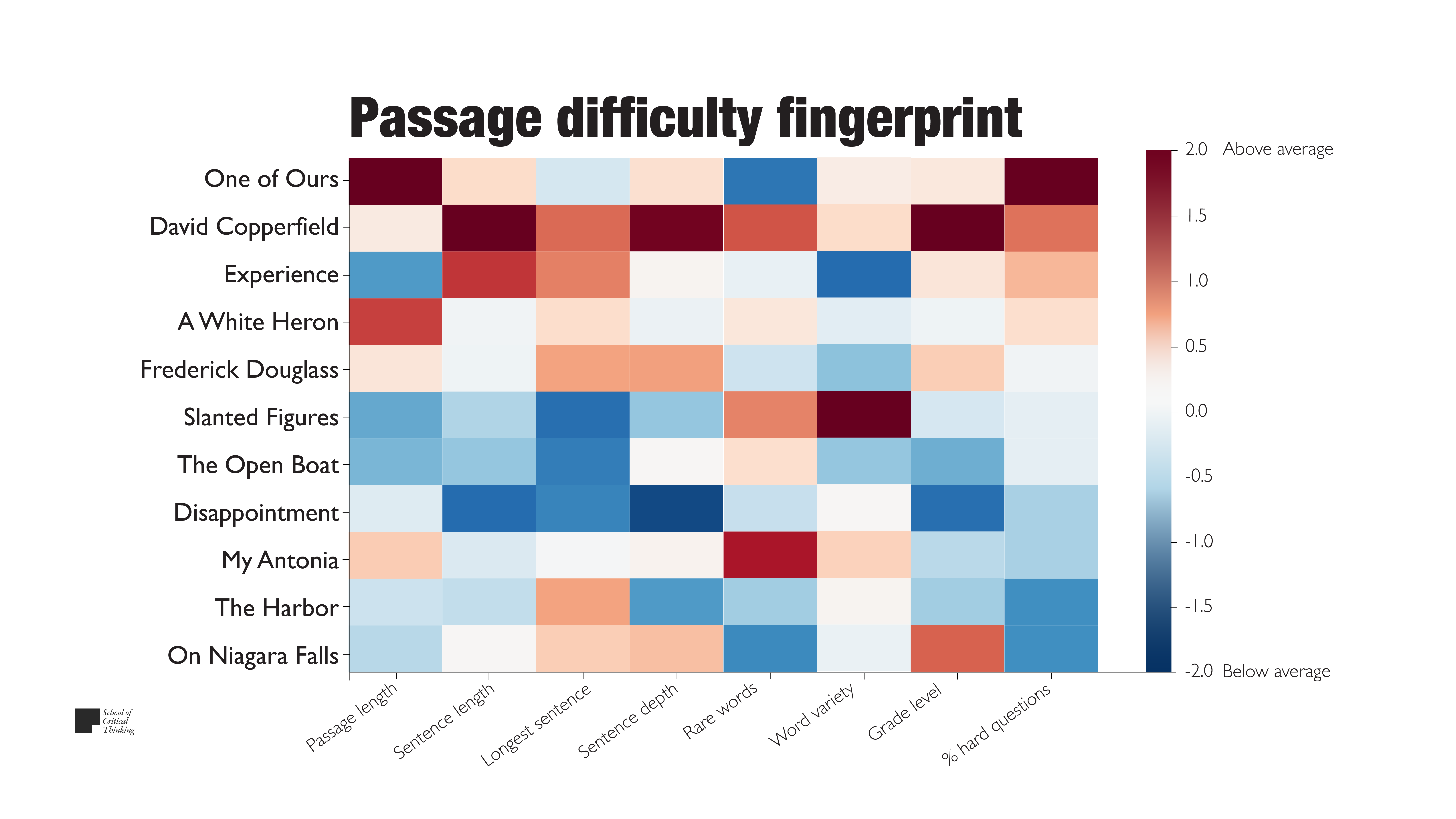
Look at the passages at the top of the chart, the ones with the most hard questions. What do they have in common? Mostly long, complicated sentences. What they don’t have in common is hard vocabulary: some have many rare words, some have very few. A passage full of unusual words was no more likely to have hard questions than a passage of plain ones.
There's one more pattern worth knowing. Hunter doesn't scale the number of questions to the length of the passage.
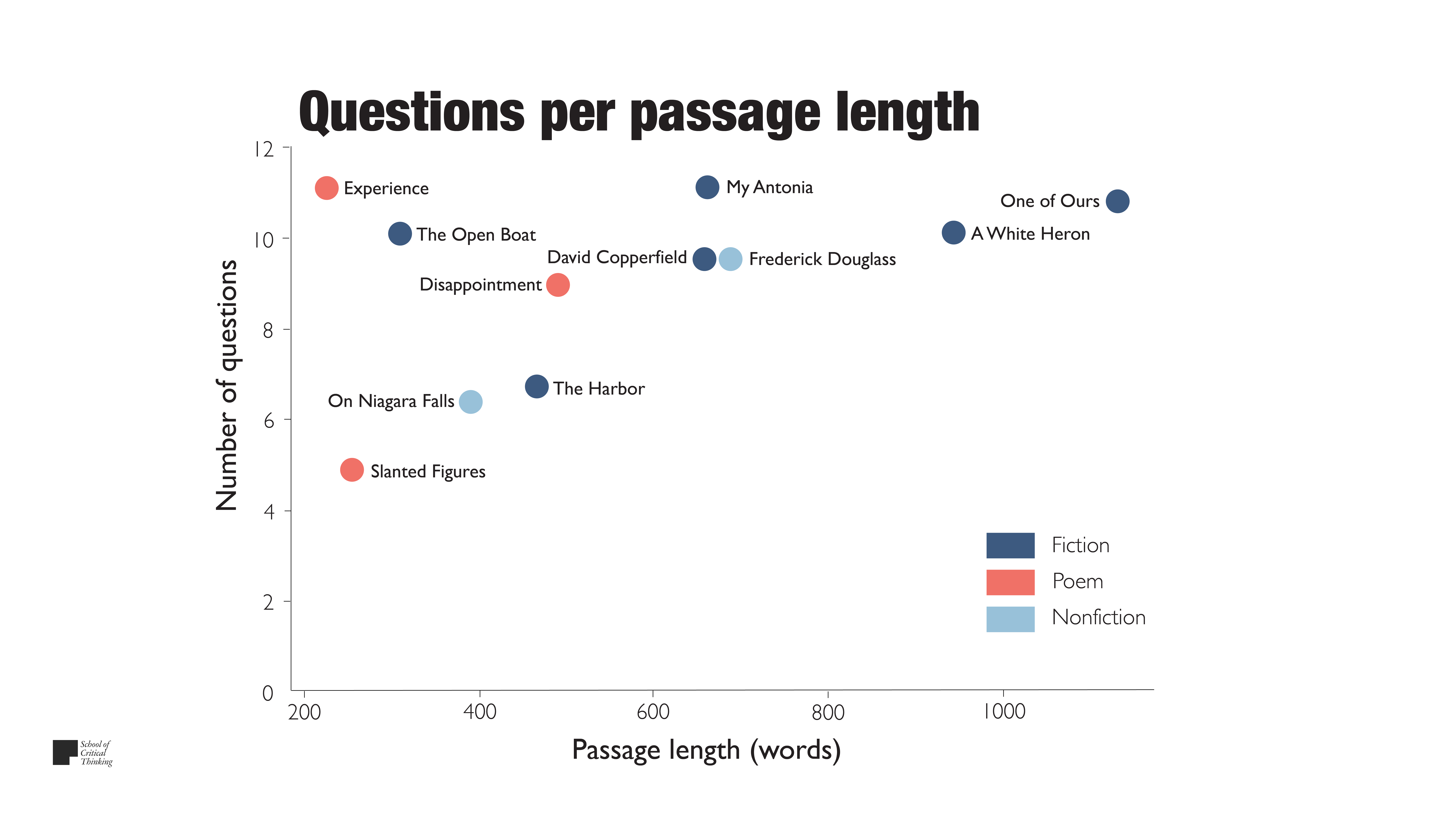
For example, Carl Sandburg's poem Experience is only 228 words long, but it carries 11 questions, as many as Cather's 1,128-word excerpt. That's about three times the usual number of questions per word.
On a short poem, nearly every line will be asked about, so your child has to read it slowly, line by line, rather than skimming for the gist.
How to prepare for Hunter reading
The main reason I publish this research is because I want to help families prepare better for the test. The analysis here gives six practical takeaways:
- Train sentences, not just vocabulary. Once or twice a week, pick a long sentence from a classic novel and take it apart with your child: Who is doing what? What's the main point? Which parts are extra information? Ask them to say it back in one short sentence. This is the skill most closely tied to Hunter's hardest questions.
- Read the classics, preferably out loud. Dickens, Cather, Jewett, Twain, Alcott, Douglass, Sandburg. Reading aloud forces a child to follow the full shape of a long sentence instead of skipping through it, and it builds the old-world vocabulary (bough, fowls, slush) the passages actually use. Many of these books are free online.
- Skip the vocabulary-list drills. The rare words in Hunter passages are mostly concrete, descriptive words that lists don't cover, and vocabulary showed no connection to hard questions. The time is better spent on reading and on working out unfamiliar words from the sentence around them.
- Don't choose practice texts by grade level. The formulas rate classic fiction as easy when it isn't. Choose by kind of text instead: older fiction, poems, and essays with long, layered sentences.
- Measure your child's reading speed. Have them read a page of a classic novel silently for three minutes, count the words, and divide by three. At 150 words per minute, the passages alone take about 20 of the 70 minutes; at 250, about 12. If speed is low, regular reading over months is the fix, so start early.
- Slow down on short poems. A short poem can carry as many questions as a long story. Teach your child to read poems line by line, asking what each line is doing, instead of reading for the general idea.
Where to go from here
Knowing what the passages are made of is half the picture. The other half is knowing how your child handles them: whether they lose the thread in long sentences, misread tone, or run out of time.
That's what our Hunter practice tests at the School of Critical Thinking are built to show. The passages are chosen and measured to match the profile you've seen here (the same kinds of texts, sentence weight and length), and after each test you see accuracy by skill and the specific kinds of wrong answers that caught your child. You can start with the free Hunter Baseline test.
In the next article, I'll turn from the passages to the questions themselves: the handful of question types that make up the reading section, and which ones decide the score. Sign up below to receive them in your inbox.
A note on method
The analysis covers the eleven passages from Hunter's two official sample tests. Every measure was computed with standard language-analysis tools (sentence splitting, part-of-speech tagging, sentence diagramming, and word-frequency data for English). The difficulty of each question is my own estimate, since Hunter doesn't publish how students performed. Eleven passages is a small sample, so read the patterns as strong hints rather than laws. The direction, though, is consistent across every measure of sentence structure.
Good luck!
Stay sharp
New research and test-prep insights, straight to your inbox.
What next?
Start with a free baseline test. Full exam, full error analysis, no credit card.
SHSAT Prep
Full-length adaptive practice tests reverse-engineered from the official DOE handbooks. Free baseline test with error analysis.
Start SHSAT prep →See the science behind it
How we analyzed over 1,300 questions and five thousand answer choices to figure out what the SHSAT is really made of.
See the method →Free baseline test
100 questions. Full error analysis. No credit card required.
Start the free baseline test →